

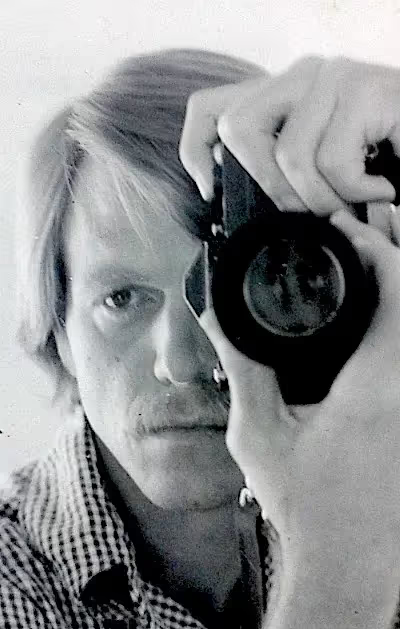
Billy Corben makes movies about subjects some people would rather forget.
For over a decade, the Fort Myers-born filmmaker has produced and directed—alongside partner Alfred Spellman—documentaries that dive headfirst into contentious, often uncomfortable stories. Corben admits his films can be disturbing, but he’s clear about his goal: “stories that are worth telling; stories that have drama, conflict and controversy.”
If a young Corben had connected with the ball at his first T-ball game, some of those films might never have happened.
“I struck out,” he says with a laugh.
“Why was that so bad?” he was asked. “You were only a kid.”
“We were playing T-ball,” Corben replied.
So, washed up as an athlete at age 7, Corben started looking for a new hobby.
Living in North Miami Beach, he remembers a neighborhood girl who acted in commercials. Any activity that didn’t involve public humiliation via plastic bat sounded good.
After getting professional headshots, he convinced his dad to take him to castings. He landed a few commercials, then summers in LA shooting TV pilots. At 9, he appeared in Ron Howard’s Parenthood.
His mother wanted no part of it. To her, Hollywood was a straight line to moral ruin.
Home-schooled during his acting years, Corben decided as a teen he wanted a normal school experience. He enrolled at Highland Oaks Middle School off Ives Dairy Road, where a teacher paired him with Alfred Spellman to produce the school’s daily news program. A partnership was born.
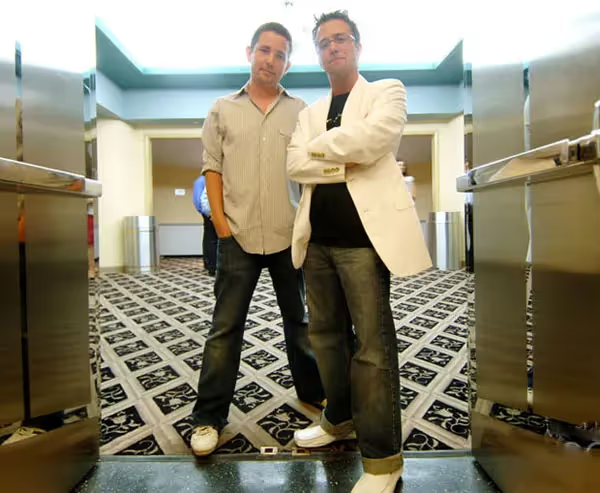
For high school, Corben chose the New World School of the Arts magnet in downtown Miami; Spellman went to North Miami High.
In 1994, they formed Spellman-Corben Productions and soon produced a student short, Waiting—a 34-minute film about a girl awaiting AIDS test results.
By 2000, Corben was at the University of Miami. That same year, he took a leave from UM, and with Spellman they made their first Rakontur documentary: Raw Deal: A Question of Consent. It centered on an exotic dancer who filed rape charges after a Gainesville frat party in 1999—only to be arrested two days later for filing a false report.
Premiered at Sundance in 2001, one critic called it “the most important film to see at Sundance.” Corben now says Raw Deal “started it all.”
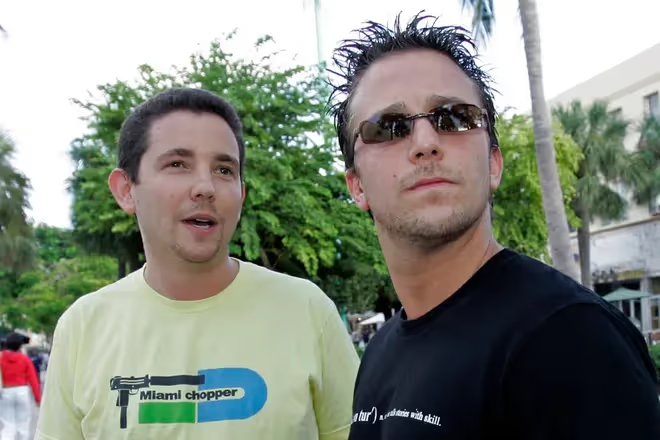
They followed with Cocaine Cowboys (2006) and Cocaine Cowboys II (2008), chronicling the violent cocaine trade’s impact on 1980s Miami.
In 2009 came the acclaimed The U—recounting how coach Howard Schnellenberger rebuilt UM’s football program in the 80s by recruiting from Miami’s toughest neighborhoods. The Canes’ smash-mouth, trash-talking style won games but made few friends outside Miami—and made UM leadership uneasy.
When Corben and Spellman approached UM about the film, they were told to “rethink even doing this project.” They persisted. The film aired on ESPN after the Heisman Trophy ceremony in December 2009.
Last March, Rakontur’s "Square Grouper" premiered at the South by Southwest Festival in Austin. Using archival news clips and sharp interviews, it tells the story of 1970s/80s South Florida marijuana culture.
(“Square grouper” = bales of pot thrown overboard or out of planes, found floating in South Florida waters.)
Broken into three parts, the film covers:
In July 1983, federal agents blockaded the only road into town and arrested a dozen fishermen. Over the years, 100+ Everglades City residents would be arrested.
In contrast to the violent cocaine cowboys, Miami’s marijuana smugglers were “cooler, calmer, and for the most part, nonviolent,” one writer noted.
Corben faced resistance before cameras rolled. Federal Judge James Lawrence King (who presided over Black Tuna trials) declined an interview, citing alleged threats from former gang members. Robert Platshorn (served 28+ years, released 2008) did participate.
Everglades City was especially tough. In a town of ~500 where most adults had ties to smuggling (or knew someone who did), memories of arrests and jail were raw. Some still resented a network TV reporter they felt betrayed them. The local grocery store even sold T-shirts with a fish and the slogan: “Keep your mouth shut and you won’t get caught.”
The town wanted nothing to do with Corben or his film.
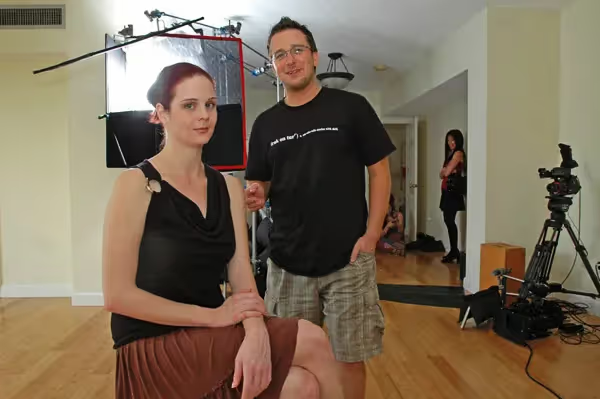
Enter Lindsey Snell, the film’s producer.
Snell grew up in Daytona Beach, studied law at Fordham in NYC, then moved to Miami Beach in 2008 intending to take the bar. Instead she joined Rakontur as a researcher.
Corben describes the 26-year-old as having “the mind of an attorney, the wit of a satirist, the face of an angel and the heart of a storyteller.”
Snell decided bonding was the key to Everglades City cooperation. So for several months in summer 2009, she drove the 80 miles out every other Saturday, hanging out at the rough-and-tumble Leebo’s Rock Bottom Bar.
At first, “They thought I was a narc.” That changed “when they saw how much I could drink.”
Saturday nights in “Florida’s Last Frontier” weren’t exactly relaxing. She was “hit on by men 50 years my senior too many times to count,” splattered with blood during a bar brawl, and once had a woman pull a knife on her, accusing her of exploiting the town.
Corben and crew eventually got their interviews. The final cut wrapped in January 2011.
Snell screened an edited version of the Everglades City segment at Leebo’s last November. “They came all dressed up like it was a Hollywood premiere,” she said. “It was cute.”
Corben stresses they didn’t just “go in, make the film, and leave forever.” After a recent Fort Myers shoot, he and Snell “took the long way back and stopped in Everglades City for dinner.”
"Square Grouper" screened at college campuses and festivals in Tampa, Sarasota, Orlando, and Boca Raton in March/April 2011. In Miami, it played at O Cinema in Wynwood April 14–17.
While Corben is glad two years of work are done, “it’s anti-climactic,” he says. “I won’t feel like the film has really been released until it’s screened in Miami.”

Billy Corben remains one of Miami’s most respected and prolific documentary filmmakers. Through Rakontur (rakontur.com), he and Alfred Spellman continue producing hard-hitting, story-driven films that explore Florida’s complex history, crime, culture, and characters.
Recent highlights include Cocaine Cowboys: The Kings of Miami (Netflix, 2021), diving deeper into the 1980s drug trade; The U: Part 2 (2022–2023 updates on the University of Miami football saga); and ongoing projects on South Florida’s underbelly and triumphs. Rakontur’s work has aired on ESPN, Showtime, Netflix, and major festivals, earning acclaim for fearless storytelling and sharp visuals.
Corben stays based in Miami, often speaking at panels, teaching masterclasses, and championing local filmmaking. His films continue to spark conversation—exactly what he set out to do: tell the stories worth telling, no matter how messy or controversial.
If you haven’t seen his catalog, start with Cocaine Cowboys or Square Grouper—they’re still as gripping (and relevant) today as they were at premiere. Miami’s past keeps fueling his lens, and he’s far from done.
Editor’s Note: Originally published April 05, 2011. Updated in 2026; while preserving Bill Cooke's perspective.

Lorem ipsum dolor sit amet, consectetur adipiscing elit. Suspendisse varius enim in eros elementum tristique. Duis cursus, mi quis viverra ornare, eros dolor interdum nulla, ut commodo diam libero vitae erat. Aenean faucibus nibh et justo cursus id rutrum lorem imperdiet. Nunc ut sem vitae risus tristique posuere.
Lorem ipsum dolor sit amet, consectetur adipiscing elit. Suspendisse varius enim in eros elementum tristique. Duis cursus, mi quis viverra ornare, eros dolor interdum nulla, ut commodo diam libero vitae erat. Aenean faucibus nibh et justo cursus id rutrum lorem imperdiet. Nunc ut sem vitae risus tristique posuere.
Check out our top local tours on Miami Beach 411—no tourist traps, just the best adventures, Everglades, and more.
Book Your TourOr book your hotel through our Hotels.com partnership—it helps keep Miami Beach 411 free and independent for everyone.
Book Your Hotel

Comment disclaimer:
Some comments below originated on a previous version of MiamiBeach411.com. As a result of platform migrations, displayed comment dates may reflect import timestamps rather than original posting dates. Many comments date back to the early 2000s and capture community conversations from that time. If you have local insight, updates, or memories to share, we welcome your comments below.
This story has been part of Miami Beach conversations for decades—and it’s still unfolding. Add your voice.
Lorem ipsum dolor sit amet, consectetur adipiscing elit. Suspendisse varius enim in eros elementum tristique. Duis cursus, mi quis viverra ornare, eros dolor interdum nulla, ut commodo diam libero vitae erat. Aenean faucibus nibh et justo cursus id rutrum lorem imperdiet. Nunc ut sem vitae risus tristique posuere.
Lorem ipsum dolor sit amet, consectetur adipiscing elit. Suspendisse varius enim in eros elementum tristique. Duis cursus, mi quis viverra ornare, eros dolor interdum nulla, ut commodo diam libero vitae erat. Aenean faucibus nibh et justo cursus id rutrum lorem imperdiet. Nunc ut sem vitae risus tristique posuere.