


For many Americans, the Mariel boatlift will forever be associated with the movie Scarface—the 1983 classic about Cuban refugee Tony Montana, who arrived in Miami chasing the American Dream. While the film captured some of the truth, the reality of Mariel was far more complex.
Yes, Fidel Castro opened his jails in 1980, sending criminals, addicts, and the mentally ill to Miami, which contributed to skyrocketing crime rates. But after the initial chaos, the majority of Marielitos became law-abiding citizens: college graduates, business owners, doctors, lawyers, engineers, and even a Pulitzer Prize-winning journalist. For a group once labeled escoria—scum by their fellow Cuban exiles—they made a remarkable mark on their new home.
Mirta Ojito, who arrived at 16, didn’t speak a word of English. She is now a Pulitzer Prize-winning journalist and teaches at Columbia University. In 2005, she published Finding Mañana: A Memoir of a Cuban Exodus, a personal account of her journey and the historical exodus.

Ojito was one of 125,000 refugees who landed in South Florida during the five-month boatlift, an event that reshaped Miami politically, culturally, and linguistically for decades.
The exodus began on April 1, 1980, when Hector Sanyustiz and four other Cubans crashed the Peruvian embassy gates in Havana demanding political asylum. Within hours, thousands of Cubans converged on the embassy, and Castro responded by opening the port of Mariel to anyone wishing to leave, provided they had someone to receive them in the U.S.

By the end of May, more than 94,000 Cubans had arrived in the United States. By October, the total reached 125,000. Miami’s murder rate doubled, though not solely due to Mariel—it was also the Colombian cocaine cowboys and other preexisting crime that had already destabilized the city.
Journalist Edward Schumacher of The New York Times reported on overcrowded boats, describing passengers as “criminals and mentally retarded people,” reflecting the alarmist tone of the time. While some Marielitos were hardened criminals, the majority quickly assimilated, disproving early negative stereotypes.
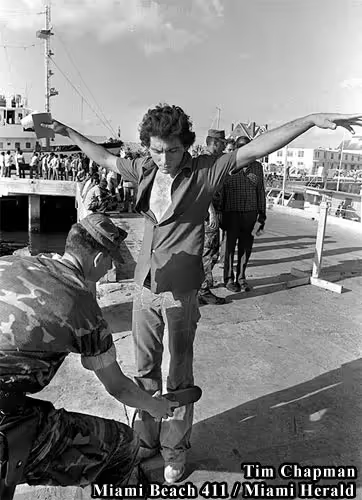
The Miami Police Department, unprepared for the influx, became overwhelmed. Hiring surges led to poorly vetted recruits, some of whom engaged in corruption, contributing to Miami’s reputation as one of the most troubled cities in the early 1980s.
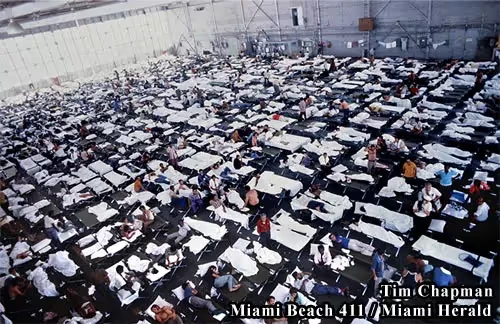
Despite early chaos, most Mariel refugees quietly integrated into Miami. By 1985, they had helped elect Xavier Suarez, the city’s first Cuban-born mayor. Their arrival also strengthened Miami’s Cuban exile population, which continues to wield substantial political influence today.
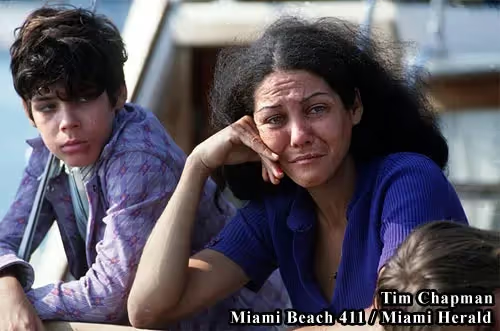
The Mariel boatlift had lasting consequences: revitalizing South Beach’s Art Deco district, shaping Miami’s multicultural identity, and establishing a resilient community that overcame prejudice and adversity. For many, the Marielitos’ story is a testament to the power of perseverance, adaptation, and hope in the face of immense challenges.

Editor's Note: This article was originally published on April 10, 2009. Updated in 2026 with new photography; while preserving Carlos Miller's original perspective.

Lorem ipsum dolor sit amet, consectetur adipiscing elit. Suspendisse varius enim in eros elementum tristique. Duis cursus, mi quis viverra ornare, eros dolor interdum nulla, ut commodo diam libero vitae erat. Aenean faucibus nibh et justo cursus id rutrum lorem imperdiet. Nunc ut sem vitae risus tristique posuere.
Lorem ipsum dolor sit amet, consectetur adipiscing elit. Suspendisse varius enim in eros elementum tristique. Duis cursus, mi quis viverra ornare, eros dolor interdum nulla, ut commodo diam libero vitae erat. Aenean faucibus nibh et justo cursus id rutrum lorem imperdiet. Nunc ut sem vitae risus tristique posuere.
Check out our top local tours on Miami Beach 411—no tourist traps, just the best adventures, Everglades, and more.
Book Your TourOr book your hotel through our Hotels.com partnership—it helps keep Miami Beach 411 free and independent for everyone.
Book Your Hotel
.avif)

Comment disclaimer:
Some comments below originated on a previous version of MiamiBeach411.com. As a result of platform migrations, displayed comment dates may reflect import timestamps rather than original posting dates. Many comments date back to the early 2000s and capture community conversations from that time. If you have local insight, updates, or memories to share, we welcome your comments below.
This story has been part of Miami Beach conversations for decades—and it’s still unfolding. Add your voice.
Lorem ipsum dolor sit amet, consectetur adipiscing elit. Suspendisse varius enim in eros elementum tristique. Duis cursus, mi quis viverra ornare, eros dolor interdum nulla, ut commodo diam libero vitae erat. Aenean faucibus nibh et justo cursus id rutrum lorem imperdiet. Nunc ut sem vitae risus tristique posuere.
Lorem ipsum dolor sit amet, consectetur adipiscing elit. Suspendisse varius enim in eros elementum tristique. Duis cursus, mi quis viverra ornare, eros dolor interdum nulla, ut commodo diam libero vitae erat. Aenean faucibus nibh et justo cursus id rutrum lorem imperdiet. Nunc ut sem vitae risus tristique posuere.