

.avif)
For decades Miami both admired and imitated New York — but today it stands on its own.
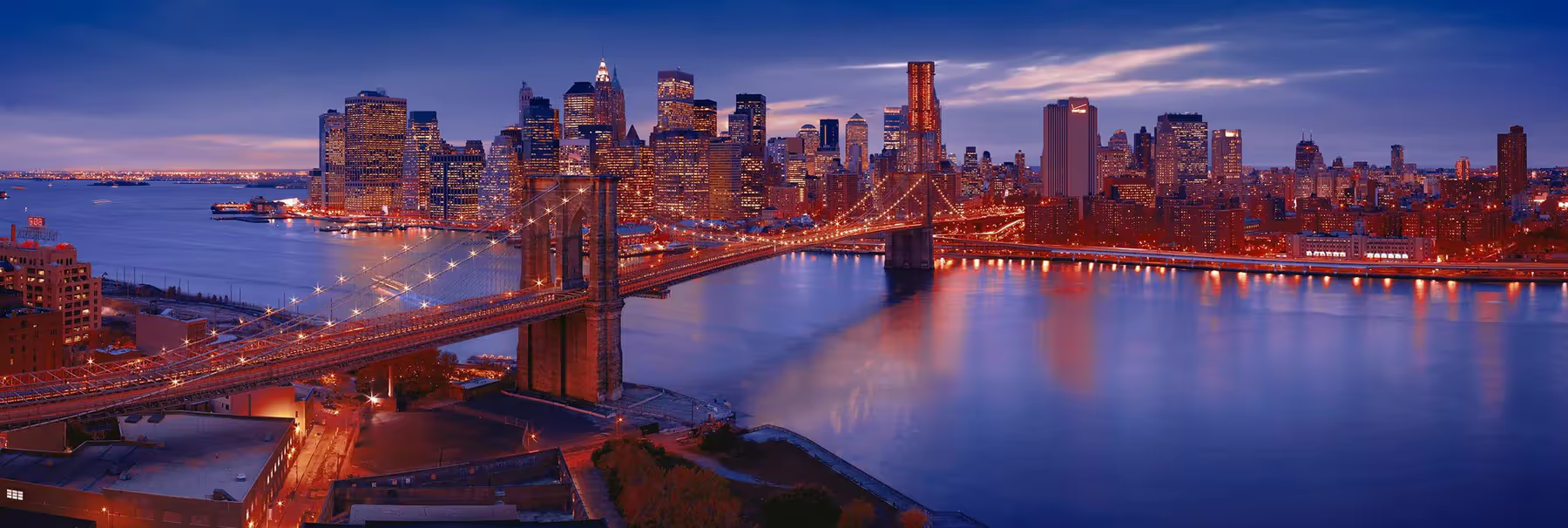
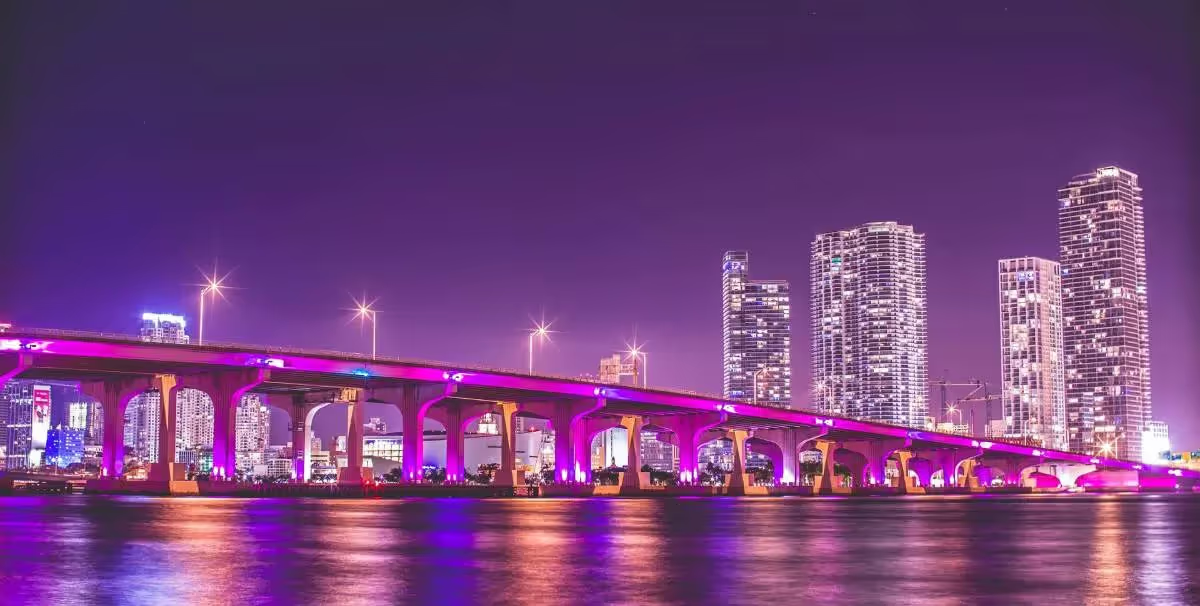
New York may have the famous Brooklyn Bridge, which is one of the oldest bridges in the country, but Miami has one of the most colorful bridges (shown below).
My Miami Beach 411 colleague Matt Meltzer recently penned an open letter to New York asking New Yorkers to "drop the attitude or stay home." Matt argues that people in Miami really don’t care if you’re from New York so get over yourselves.
He described New Yorkers as “obnoxious tourists” with condescending put-downs and arrogant attitudes. He said they do nothing but proclaim how everything is better in “The City.”
But what he doesn’t mention is that Miami has always had New York envy.
Take it from this Miami native: If there’s one city that Miami has always tried to emulate, it’s the Big Apple. It’s the only American city that Miami has any real respect for. The rest might as well be Mayberry for all we care.
This isn’t to say Miami is on equal footing with New York. As far as population and history go, New York will always overshadow Miami—like a big brother lording over his kid brother.
But that has never stopped Miami from believing it’s New York South. In fact, Miami has long been known as the Sixth Borough because of all the New Yorkers who transplanted here over the decades.
Although we’re the southernmost city in the continental United States, our southern hospitality has long been overshadowed by our northern temperament.
As the old saying goes in Miami,
“The further north you drive, the deeper south you get.”
It all started in the late 1800s with a New York tycoon named Henry Flagler, who extended his railroad to the southern tip of Florida—back when it was nothing but a mosquito-infested swampland. That led to the incorporation of Miami in 1896, along with the development of streets, buildings, and infrastructure.
By the early 1900s, Miami had been nicknamed “The Magic City” because it seemingly became a city overnight without ever being a town. And it was already a favorite winter getaway for rich New Yorkers, including Andrew Carnegie and John D. Rockefeller, who would spend their winters at Flagler’s Royal Palm Hotel on the mouth of the Miami River.

By the 1920s, a man named Carl Fisher built what he called “the Fifth Avenue of the South”—today known as Lincoln Road. And a man named John Collins built what he called the “Atlantic City of the South”—the hotels and casinos he developed along Ocean Drive in what’s now the Art Deco District.
And thus Miami Beach became a prime winter getaway for New Yorkers, complete with entertainment acts from all over the world. Many decided to buy property here and relocate permanently.
By the 1930s, Miami’s historic black neighborhood, Overtown, became known as “Little Broadway” because even though Duke Ellington, Louis Armstrong, Cab Calloway, Count Basie, and Ella Fitzgerald were allowed to perform on Miami Beach, they weren’t allowed to sleep in its hotels. So they stayed in Overtown and gave after-hours performances that lasted until daylight.
By the mid-20th century, our admiration began to shift…
The New York influence continued during the post-World War II years when a New York developer named Morris Lapidus built the Fontainebleau Hotel in 1954 and the Eden Roc Hotel in 1955, which continued to attract New York tourists—many of whom became permanent residents.
It was around this time that New York gangster Meyer Lansky made his home in Miami, where he operated one of the largest gambling empires in the United States.
By 1964, Brooklyn-born comedian Jackie Gleason moved his television show from New York City to Miami Beach, where it aired for another six years. Around the same time, hundreds of thousands of Cubans began emigrating to Miami, processed inside the Freedom Tower in downtown Miami—known today as Miami’s Ellis Island. Through it all, New Yorkers continued to move down by the thousands, especially Jewish families. By the late 1960s, more than 100,000 Jews had relocated from New York to Miami Beach.

By the 1970s—when I was growing up in Miami—we all knew somebody who had just moved down from New York. Whether it was the Italian kid from the corner, the Jewish kid down the street, or in many cases, the Cuban kid who wore T-shirts to school on those rare nippy days when the rest of us wore jackets.
The New York kids were streetwise, fast-talking, and tough-acting. They always had our respect. But we also earned their respect by showing them we were no slouches either.
In 1981, during the height of the Cuban crime wave in Miami, my social studies teacher announced that Miami’s crime rate had surpassed New York City’s.
We all cheered. It was as if we had finally come of age as a city. We were proud to no longer be viewed as a tourist/retirement haven but as an urban metropolis in our own right.
It was around this time that the famous New York Jets–Miami Dolphins football rivalry began to intensify. And that rivalry later extended to the basketball court between the Miami Heat and the New York Knicks, and today to the Florida Marlins and New York Mets on the baseball field.
Not to mention the Marlins’ victory over the New York Yankees in the 2003 World Series.
The rivalry even spilled into the newsrooms in 1987 after the New York Times published a scathing piece titled “Can Miami Save Itself? A City Beset by Drugs and Violence,” which prompted the Miami Herald to send Dave Barry to New York to write an article titled “Can New York Save Itself?”
Above: New York has subways and street musicians.
Above: Miami has street musicians on Lincoln Road, which was originally dubbed “the Fifth Avenue of the South.”
The rivalry has also extended into the nightclub scene after South Beach emerged as one of the world’s hottest clubbing destinations in the 1990s—after emulating, of course, the New York style of velvet ropes, discriminating doormen, and long after-hours. And when New York nightclubs started promoting bottle service in the 1990s, South Beach’s nightclubs followed suit a few years later.
The New York-Miami connection is not much different than a sibling rivalry between an older and younger brother. Only now the younger brother is no longer a kid—and he can hold his own.
While the older brother will always have the advantage of age, experience, and wisdom, the younger brother will always be cocky, feisty, and stubborn.
Today, Miami doesn’t need New York’s approval — it defines its own culture, style, and swagger.
That’s not to say we don’t care how you do it up north. We already know.
It’s just that now we’re old enough to show you how it’s done.
Editor’s Note: Originally published May 13, 2009. Updated in 2026 with new photography, while preserving Carlos Miller's perspective.

Lorem ipsum dolor sit amet, consectetur adipiscing elit. Suspendisse varius enim in eros elementum tristique. Duis cursus, mi quis viverra ornare, eros dolor interdum nulla, ut commodo diam libero vitae erat. Aenean faucibus nibh et justo cursus id rutrum lorem imperdiet. Nunc ut sem vitae risus tristique posuere.
Lorem ipsum dolor sit amet, consectetur adipiscing elit. Suspendisse varius enim in eros elementum tristique. Duis cursus, mi quis viverra ornare, eros dolor interdum nulla, ut commodo diam libero vitae erat. Aenean faucibus nibh et justo cursus id rutrum lorem imperdiet. Nunc ut sem vitae risus tristique posuere.
Check out our top local tours on Miami Beach 411—no tourist traps, just the best adventures, Everglades, and more.
Book Your TourOr book your hotel through our Hotels.com partnership—it helps keep Miami Beach 411 free and independent for everyone.
Book Your Hotel

Comment disclaimer:
Some comments below originated on a previous version of MiamiBeach411.com. As a result of platform migrations, displayed comment dates may reflect import timestamps rather than original posting dates. Many comments date back to the early 2000s and capture community conversations from that time. If you have local insight, updates, or memories to share, we welcome your comments below.
This story has been part of Miami Beach conversations for decades—and it’s still unfolding. Add your voice.
Lorem ipsum dolor sit amet, consectetur adipiscing elit. Suspendisse varius enim in eros elementum tristique. Duis cursus, mi quis viverra ornare, eros dolor interdum nulla, ut commodo diam libero vitae erat. Aenean faucibus nibh et justo cursus id rutrum lorem imperdiet. Nunc ut sem vitae risus tristique posuere.
Lorem ipsum dolor sit amet, consectetur adipiscing elit. Suspendisse varius enim in eros elementum tristique. Duis cursus, mi quis viverra ornare, eros dolor interdum nulla, ut commodo diam libero vitae erat. Aenean faucibus nibh et justo cursus id rutrum lorem imperdiet. Nunc ut sem vitae risus tristique posuere.