

Everyone around them hates them. And the people who surround them all believe their little sliver of land – be it a bike lane, sidewalk or West Bank - belongs to them instead. So cyclists have to be extra vicious and aggressive in order to survive.
And while that kind of attitude is defensible when facing a perpetual threat of total annihilation, it’s a little extreme when going for some afternoon exercise.
Understandable, Miami streets are dangerous for those on two wheels. 2009 saw 12 cyclists killed on Dade County roadways. Twice the number from 2008. And that problem is not exclusive to just Southern Florida; in that same 2008 where we only had six cyclists killed, the State had 125, accounting for four percent of statewide traffic fatalities. And while poor driving and a lack of bike lanes are certainly part of the problem, cyclists making poor decisions contribute as well.
It is an odd phenomenon, but who among us has not seen a cocky cyclist breeze through an intersection when no cars are coming? I frequently find myself on my bike, stopped, waiting for the signal to change, getting yelled at and buzzed by other cyclists who think I’m wrong for yielding to lawful traffic.
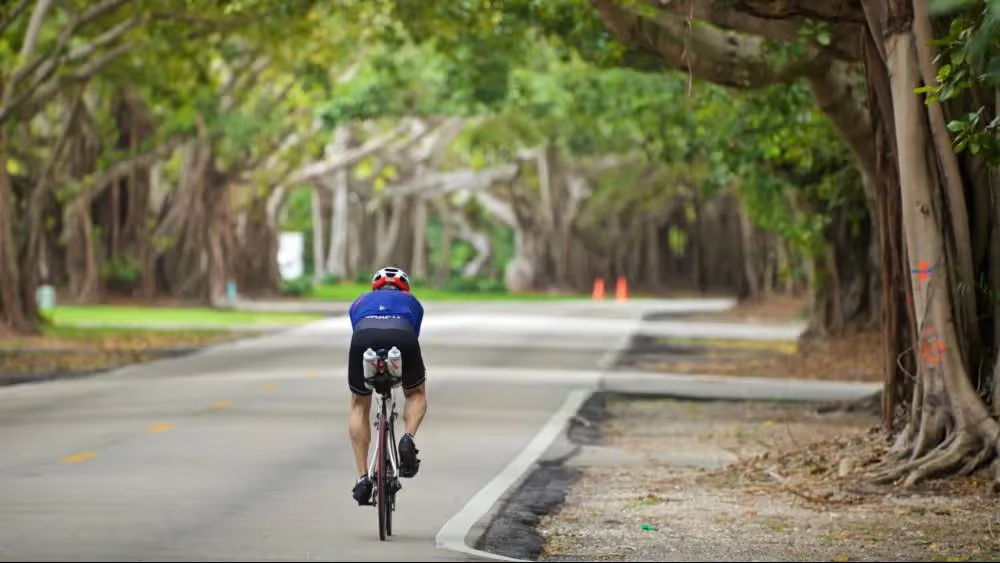
As a cyclist, if one is going to demand cars follow the rules, one should lead by example. And the majority of cyclists - as seen in our video above - keep to the right and are mindful of motorists. But the proximity to traffic leaves little margin for rule-breaking. It’s that percentage of cyclists who think they own the road who cause the problems.
After my last article (In Miami, We Don’t Stop for Pedestrians) many people attacked me for being irresponsible and a danger on the roads. And much of this vitriol came from the cycling community. Odd, as I would wager I spend more miles on a bike than most of them. The difference is that I – like some others – understand that following the rules will get me a lot further than blatantly breaking them.
While “Share the road” seems to be a rallying cry for those in the cycling community, many don’t seem to think that includes sharing it with cars. Drive north on Old Cutler Road on a Saturday or Sunday morning and you’ll be hard pressed NOT to be stuck behind a cyclist who believes his or her bicycle can take up an entire lane. Old Cutler, for those not in Miami, is a two lane road. Meaning a pack of cyclists going 20 miles an hour will hold up a line of cars behind it with little conscience. Others try and pass cars stuck in traffic on the vehicles’ right, thinking their slimmer frame somehow makes this maneuver perfectly legal. And while some do it with ease, others don’t fare so well.
Many dart out into a steady stream of vehicular traffic, again assuming that because they’re not in a car, people will stop.
Some do. Some do not. But better to have to take an extra few minutes on your bike ride and live to ride another day. It’s not only courtesy, it’s common sense.
Furthermore, in order to bike safely you must accept drivers in Miami are not courteous. You can’t bicycle in Miami like you might on a bike trail in North Florida. And as spectacular as the views are from the Rickenbacker, taking the time to look at them can literally get you killed.
Traffic will swerve into the bike lane. Cars will cut you off without signaling. And people will stop in your path to take pictures. On the MacArthur and Julia Tuttle Causeways, people are sometimes drunk, even in the morning. In Miami, you don’t just bike defensively; you bike like you’re under attack.
So cyclists, maybe if more of us can start following the rules—you know the same ones we demand motorists follow—the roads can be safer for everyone. But as long as people in Miami ride their bikes with the same reckless disregard they drive their cars, the war for the roads will continue.
Editor’s Note: Originally published July 09, 2012. Updated in 2026 with new photography; Matt Meltzer’s original writing remains unchanged.

Lorem ipsum dolor sit amet, consectetur adipiscing elit. Suspendisse varius enim in eros elementum tristique. Duis cursus, mi quis viverra ornare, eros dolor interdum nulla, ut commodo diam libero vitae erat. Aenean faucibus nibh et justo cursus id rutrum lorem imperdiet. Nunc ut sem vitae risus tristique posuere.
Lorem ipsum dolor sit amet, consectetur adipiscing elit. Suspendisse varius enim in eros elementum tristique. Duis cursus, mi quis viverra ornare, eros dolor interdum nulla, ut commodo diam libero vitae erat. Aenean faucibus nibh et justo cursus id rutrum lorem imperdiet. Nunc ut sem vitae risus tristique posuere.
Check out our top local tours on Miami Beach 411—no tourist traps, just the best adventures, Everglades, and more.
Book Your TourOr book your hotel through our Hotels.com partnership—it helps keep Miami Beach 411 free and independent for everyone.
Book Your Hotel

Comment disclaimer:
Some comments below originated on a previous version of MiamiBeach411.com. As a result of platform migrations, displayed comment dates may reflect import timestamps rather than original posting dates. Many comments date back to the early 2000s and capture community conversations from that time. If you have local insight, updates, or memories to share, we welcome your comments below.
This story has been part of Miami Beach conversations for decades—and it’s still unfolding. Add your voice.
Lorem ipsum dolor sit amet, consectetur adipiscing elit. Suspendisse varius enim in eros elementum tristique. Duis cursus, mi quis viverra ornare, eros dolor interdum nulla, ut commodo diam libero vitae erat. Aenean faucibus nibh et justo cursus id rutrum lorem imperdiet. Nunc ut sem vitae risus tristique posuere.
Lorem ipsum dolor sit amet, consectetur adipiscing elit. Suspendisse varius enim in eros elementum tristique. Duis cursus, mi quis viverra ornare, eros dolor interdum nulla, ut commodo diam libero vitae erat. Aenean faucibus nibh et justo cursus id rutrum lorem imperdiet. Nunc ut sem vitae risus tristique posuere.