


Carl Fisher may have been the man who transformed a mosquito-infested mangrove swamp into Miami Beach, but it was Steve Hannagan who made sure the world knew it existed.
By the early 1920s, Fisher was well on his way to building both Miami Beach and a personal fortune. But he faced an unexpected problem: Northern newspapers made no distinction between Miami and Miami Beach. In press reports, the two were treated as the same place—and Fisher understood that branding mattered.
In 1924, Fisher crossed paths with Steve Hannagan, a 24-year-old press agent who had previously worked for him in Indianapolis. Fisher didn’t hesitate. He hired Hannagan on the spot and gave him one clear mission: get Miami Beach its own name in the headlines.
Hannagan wasted no time. Within days, he landed his first story—sensational and perfectly timed. A millionaire had collapsed and died while playing polo on Miami Beach. Hannagan rushed the item to United Press with an unmistakable instruction:
It became Hannagan’s guiding rule: print anything you want about Miami Beach—good or bad—just make sure you get the name right.
By 1925, Hannagan had opened the Miami Beach News Bureau, staffed with writers and photographers. Each winter, the bureau sent a steady stream of stories and images from Carl Fisher’s island paradise—all carrying the Miami Beach dateline.

Steve Hannagan—sometimes called the P.T. Barnum of his day—knew a secret: subtle sex sells. He combed Miami Beach high schools for pretty girls, had them photographed in bathing suits enjoying the sun and surf, and sent those pictures to newspapers across the United States.
By 1925, Steve Hannagan had formalized his publicity machine, opening the Miami Beach News Bureau, staffed with writers and photographers whose sole job was selling Fisher’s island paradise. Each winter, the bureau fed newspapers a steady diet of stories and sun-drenched images—all stamped with the Miami Beach dateline.

Sometimes called the P.T. Barnum of his era, Hannagan understood a simple truth long before marketers gave it a name: subtle sex sells. He scouted attractive young women, photographed them enjoying the beach in fashionable bathing suits, and mailed the images to editors across the country.

Northern editors didn’t need a calendar to know when tourist season had arrived. The first batch of Hannagan’s photos was winter’s announcement—Miami Beach was open for business.
By 1927, city officials were paying Hannagan $20,000 per season to manage Miami Beach’s advertising. A decade later, his work caught national attention. In November 1936, LIFE magazine devoted six pages to a feature titled “Steve Hannagan’s Girls,” praising him as
“the man who, year in and year out, gets more pictures of bathing girls in the paper.”
Hannagan continued producing what the era politely called “cheesecake” into the early 1940s, until World War II reshaped the national mood. A 1942 article noted the shift:
“Instead of lolling on the sand and cavorting in the surf… Hannagan’s bathing girls will now enlist their charms in promoting salvage drives and bond campaigns.”
By 1945, Hannagan asked the city to raise his annual retainer from $6,000 to $25,000. Officials declined, ending a 20-year partnership. But by then, the formula was baked in. Miami Beach had developed a lasting addiction to cheesecake, and long after Hannagan stepped away, photographers continued distributing sun-soaked images worldwide through wire services—keeping the fantasy alive.
The early 1950s introduced a new promotional star: Hank Meyer. His rise began almost by accident. When President Harry Truman was preparing for a 1948 visit to Key West, Meyer mailed him four tropical shirts. Truman was photographed wearing one—and suddenly, the President of the United States had become a walking Miami Beach advertisement. Meyer was soon hired as the city’s publicity director.

As television took over American living rooms, Meyer saw an opportunity. He persuaded Arthur Godfrey, Ed Sullivan, and Jackie Gleason to broadcast their shows from Miami Beach. Millions of snowbound viewers watched sun-soaked beaches, glamorous hotels, and polished nightlife beam into their homes each winter. Miami Beach wasn’t just a destination—it was aspiration. By mid-century, the city was at the very top of its game.

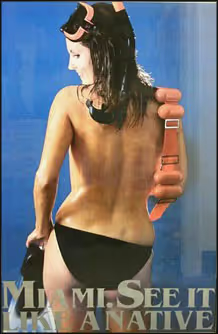
In 1979, Dade County tourism officials flirted - albeit briefly - with using sex to lure tourists.
The City hired an ad agency to come up with a campaign. With the catch phrase “Miami. See It Like A Native,” the centerpiece of the campaign was a full color poster of a female skin diver wearing a bikini bottom and no top with her back to the camera. It was tame by today’s standards. But when some women’s activists saw the poster, they exploded. “Sexist,” they called it. The county commission caved in and ordered the posters - all 23,000 - impounded. A year later they were shredded. The feminists had won again!
As the 1970’s gave way to to the 1980’s, South Florida’s and Miami Beach’s image as a carefree tourist destination was about to take multiple hits.
Miami Beach’s carefully curated fantasy of glamour and sex was no longer the only story being told.
But by the late 1970s, the mood began to shift. The women’s movement increasingly criticized “girlie photos” as demeaning, and when Dade County briefly experimented with sexualized advertising, feminist backlash shut it down fast. At the same time, a series of urban crises—the Mariel boatlift, the McDuffie riots, escalating drug wars, and rising homicide rates—reshaped the national perception of South Florida.
Yet the 1980s delivered a fresh wave of glamour. South Beach—then a fading stretch of Art Deco buildings occupied by retirees, refugees, and small-time criminals—caught the attention of European fashion photographers chasing winter light. The photographers came first. The models followed. And soon after, pop culture arrived to seal the transformation.
In 1983, Brian De Palma filmed Scarface. A year later, Michael Mann’s Miami Vice exploded onto television screens. Suddenly, pastel Art Deco facades, neon nights, Italian designer suits, and foreign sports cars turned South Beach into the sexiest zip code on TV.
The image was permanently burned into the global imagination in 1986, when Bruce Weber’s Calvin Klein campaign was shot atop the Breakwater Hotel. Miami Beach was no longer just a winter escape—it was a world capital of beauty, fashion, and desire. Almost overnight, the streets filled with models, photographers, stylists, and speculators, all chasing the same thing and all with money to spend.

In February 1992, she and photographer Steven Meisel chose locations across Miami Beach for her controversial coffee-table book SEX. On the side of the road, in public view, Madonna posed nude and semi-nude at dozens of locations over two weeks, barely causing a ripple locally. But the images went global—flooding the media and giving Miami Beach unparalleled publicity.

After the shoot, Madonna bought a $4-million-plus home on the edge of Coconut Grove. Celebrities followed. Sylvester Stallone, Gianni Versace, and others planted roots, helping cement Miami Beach as a destination for fame, fortune, and allure.

South Beach soon found its own voice with Ocean Drive Magazine, founded in 1992 by Jerry Powers. The publication celebrated celebrities, fashion, and the Miami lifestyle—glossy and aspirational, without leaning on paparazzi sensationalism. But by the early 2000s, digital cameras changed everything. Suddenly, everyone was a potential paparazzo, and the spotlight on Miami Beach grew brighter—and far less controllable.

Today, paparazzi stalk the streets and beaches of South Beach. Stars lounge by day and stagger out of clubs by night, their images flashed worldwide within minutes. What once required wire services and editors now happens instantly—uploaded, shared, and dissected in real time.
At the same time, tech companies are leaving California and planting their headquarters in Miami, drawn by money, weather, and a city that still knows how to sell a fantasy. Celebrities continue to follow, turning private lives into public content simply by walking down Ocean Drive.

And then there was the line that said it all. In 2010, LeBron James announced, “I’m going to take my talents to South Beach,” a sentence that doubled as free global advertising and instantly rebranded Miami as a place where ambition, spectacle, and reinvention converge.
From bathing girls to superstars, from wire photos to livestreams, the formula hasn’t really changed—only the technology has. Somewhere, Steve Hannagan is smiling.
Editor’s Note: Originally published on September 20, 2010. Updated in 2026 with new photography; while preserving Bill Cooke's original perspective.

Lorem ipsum dolor sit amet, consectetur adipiscing elit. Suspendisse varius enim in eros elementum tristique. Duis cursus, mi quis viverra ornare, eros dolor interdum nulla, ut commodo diam libero vitae erat. Aenean faucibus nibh et justo cursus id rutrum lorem imperdiet. Nunc ut sem vitae risus tristique posuere.
Lorem ipsum dolor sit amet, consectetur adipiscing elit. Suspendisse varius enim in eros elementum tristique. Duis cursus, mi quis viverra ornare, eros dolor interdum nulla, ut commodo diam libero vitae erat. Aenean faucibus nibh et justo cursus id rutrum lorem imperdiet. Nunc ut sem vitae risus tristique posuere.
Check out our top local tours on Miami Beach 411—no tourist traps, just the best adventures, Everglades, and more.
Book Your TourOr book your hotel through our Hotels.com partnership—it helps keep Miami Beach 411 free and independent for everyone.
Book Your Hotel

Comment disclaimer:
Some comments below originated on a previous version of MiamiBeach411.com. As a result of platform migrations, displayed comment dates may reflect import timestamps rather than original posting dates. Many comments date back to the early 2000s and capture community conversations from that time. If you have local insight, updates, or memories to share, we welcome your comments below.
This story has been part of Miami Beach conversations for decades—and it’s still unfolding. Add your voice.
Lorem ipsum dolor sit amet, consectetur adipiscing elit. Suspendisse varius enim in eros elementum tristique. Duis cursus, mi quis viverra ornare, eros dolor interdum nulla, ut commodo diam libero vitae erat. Aenean faucibus nibh et justo cursus id rutrum lorem imperdiet. Nunc ut sem vitae risus tristique posuere.
Lorem ipsum dolor sit amet, consectetur adipiscing elit. Suspendisse varius enim in eros elementum tristique. Duis cursus, mi quis viverra ornare, eros dolor interdum nulla, ut commodo diam libero vitae erat. Aenean faucibus nibh et justo cursus id rutrum lorem imperdiet. Nunc ut sem vitae risus tristique posuere.