

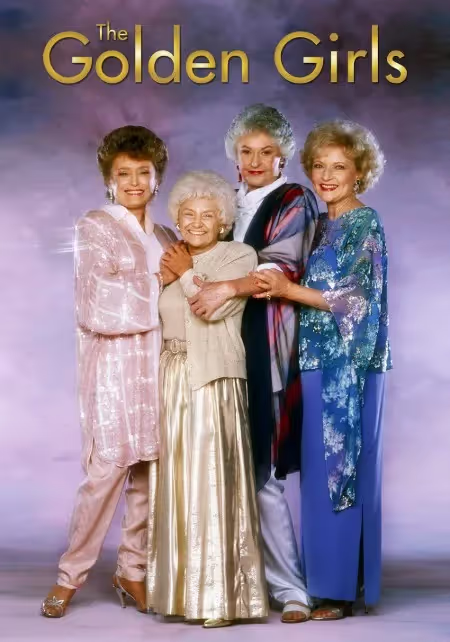
When you think of Miami in the 1980’s, and especially Television depictions of Miami in the 1980’s, one show comes to mind. And while the adventures of Crockett and Tubbs, flanked by their fast cars and pastel suits, made for exciting TV drama during South Florida’s crime heyday, there was a show set in Miami that was perhaps even more influential. Take out the beautiful women and cocaine smugglers and replace them with retired widows and cheesecake, and you have the breakthrough comedic hit of the 1980’s that was “The Golden Girls.”
“The Golden Girls” follows the lives of four elderly women living in Miami. This, you may remember, was back when there were actually old people living down here. But instead of the usual TV depiction of women over 50 as doting grandmothers who did nothing but play Bridge and buy Depends, “The Golden Girls” instead showed them as young women who happened to be a little older. The lives of the oversexed Blanche, the naive Rose, the dignified and intellectual Dorothy and her firecracker Italian mother Sofia were, in many ways, like those of women of all ages. They dated, they loved, they lost, and they dealt with issues that affected women from 18-80. Whether it was a perpetual ex who won’t leave your life, dealing with an impotent boyfriend, or facing the loss of a sibling or parent, “The Golden Girls” tackled subjects that few would have ever expected from a cast supposedly in their “Golden Years.”
The premise was rather simple: The recently widowed Blanche Devereaux needs to rent out bedrooms in her house to pay the mortgage. She puts an ad up at a supermarket and two women respond, Rose Nylund and Dorothy Zbornak. After they move in, the retirement home that Dorothy’s mother, Sofia Petrillo, lives in burns down and she comes to live in the house as well. Doesn’t sound too riveting, but that is truly what made the show great; its ability to take a seemingly dull premise and create comic genius.
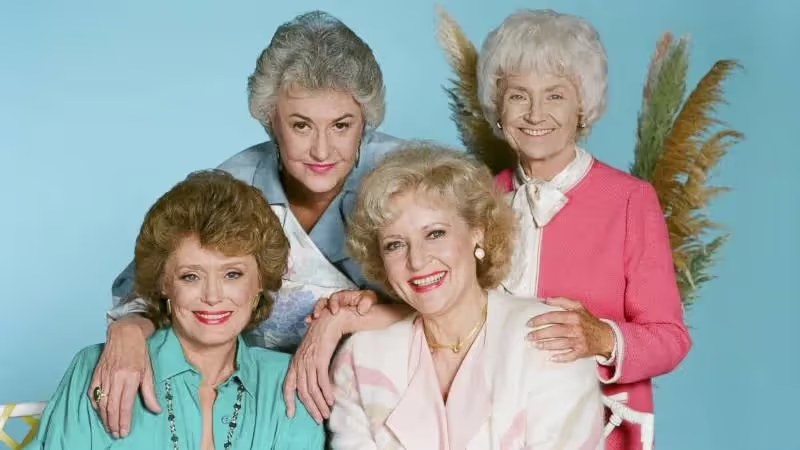
Blanche, played by Rue McClanahan, was an aging southern Belle who dealt with her insecurities about fading looks by sleeping with as many men as she could. This was not only a great comedic vehicle but also a multi-faceted portrayal of a promiscuous female. The Naïve Rose, played by Betty White, was deftly depicted as a vapid airhead, but still managed to be entertaining much further than just being plain clueless. She also wound absolutely inane stories about her life growing up on a farm in St. Olaf that provided set ups for countless jokes by her counterparts. Perhaps Rose’s biggest critic was the 80-plus year old Sofia, played by Estelle Getty. While not the focus of most of the storylines on the show, Sofia always provided the biting sarcasm that created some of the show’s funniest moments. Her recently-divorced daughter Dorothy, played by the imposing Bea Arthur, was the intellectual centerpiece of the series, infusing common sense and poise into her eccentric co-stars.
The chemistry of these four women is unmatched by any show not called “Seinfeld.” It is no coincidence, then, that “The Golden Girls” was the first program to have all of its primary characters win Emmy Awards for their Acting and Supporting Acting roles. The show also received several writing Emmys and the award for Outstanding Comedy Series in 1986 and 1987. This is in addition to several Golden Globe, American Comedy and Directors Guild Awards. The show was a roaring success and ratings had not dropped when they finally wrapped up in 1992. Bea Arthur had not reached a contract agreement and chose to leave, disrupting the chemistry and therefore making the show in its current incarnation impossible. A spinoff titled “Golden Palace” aired in late 1992 and featured the three remaining cast members running an Art-Deco hotel in South Beach, but it was cancelled before even finishing its first year. This was a true testament to how great the cast chemistry was: While arguably the three most eccentric and comedy producing characters on the show remained, the program lost nearly all of its humor simply by removing one piece.
It was the first show to depict older women as being more than just grandmothers. It was also the first long-running series to feature an all-female main cast. The closest any show has come to replicating this format with success was “Sex and The City,” which draws constant comparisons not only because of their similar character makeup but also their popularity. While “Sex” may have been a slightly smarter and certainly more glamorous show, it was not nearly as consistently funny nor did it garner the widespread appeal of the Golden Girls. I have drawn extensive character comparisons of the two shows before, and it is not even a question that while “Sex and The City” was an outstanding program, it never would have existed without their grandmothers of the 1980’s.
Garnering many awards, audience adoration and even two simultaneous spinoffs (“Empty Nest” and “Nurses”), “The Golden Girls” is undoubtedly one of the most important Sitcoms of the past 30 years. The series not only changed the way we looked at women after 50, it also managed to make a show that on its surface would only appeal to the most unpopular of demographics (women over 39) a hit that crossed gender and generational lines. While the writing team deserves a good amount of credit for this, the chemistry of the cast is what made this Miami-based sitcom the most award-winning program ever set in South Florida. Despite the fact that a scene was never filmed here and the façade for the house is on a backlot in Orlando, the Golden Girls is an indisputable part of Miami’s contribution to popular culture.
A number of people have written into us here (okay, maybe three) asking where they can find the Golden Girls’ house in Miami. Few of these people understand that the entire show was filmed on a backlot in LA and the house was actually a model at MGM Studios in Orlando (which has since been taken off the tour). So for someone in Miami to catch a glimpse of the house, all seems somewhat lost.
But not so fast.
A kind commenter was nice enough to let us know that the house where Blanche, Dorothy, Rose and Sofia spent so many nights eating cheesecake and stargazing on the lanai actually exists. It is located at 245 N Saltair Avenue in the Brentwood section of Los Angeles. Apparently it was used for the exterior shots in Season 1 before the Orlando model was built. And the owner of the property according to LA County records? Dave Barry. Not sure if it’s THE Dave Barry, but how can you possible get any more Miami than that?
I was on my way to Hawaii yesterday and somehow managed a 15-hour layover in Los Angeles. And there was no way in Hell I wasn’t going to go and pay my last respects to Bea Arthur and Estelle Getty at the home that made me move to Miami. Even if it was in Brentwood. I convinced my friend Shannon, who was nice enough to humor me for the evening, to take me the short trip up the 405 to see this piece of TV history. She mocked me endlessly, but if loving the Golden Girls is wrong, well then, “right” has no taste in television.
As we drove down Sunset I saw gate after gate blocking off the streets of Brentwood. I decided that if Saltair was gated off, I would jump the fence; I hadn’t come all the way to Los Angeles to look at a stinking gate. But by the time we got to Saltair, the gates were gone, and it was a straight shot with legal street parking to the Mecca of Golden Girls Fandom. We passed some impressive houses as I watched the numbers go up in giddy anticipation. 145, 171, 201…..

I felt as if the words “Produced by Paul Junger Witt and Tony Thomas” should have been plastered on Shannon’s windshield and the reprise of the theme music should be playing in the background. Maybe a car pulling into the driveway. It was unmistakable, and it was beautiful. There were no cars in the driveway, so we got out. I had purchased my first digital camera the day before for this momentous event, and despite the setting California sun I snapped as many pictures as I could. I’d been looking at this house since I was 4 years old, and here I was, standing in the driveway. Truly, a dream come true.
There was no fanfare at 245 N Saltair. No bouquets of flowers left in memory of Bea Arthur and no commemorative shirts. Just a house on a street with a light in the driveway. After about 15 minutes of picture taking I saw a figure in the front window moving around, and figured it wasn’t Sofia out for a late-night sleepwalk of one of Blanche’s dates sneaking out before his wife caught him. I went back to the car and headed back toward Sunset, with a camera full of memories from the best night I ever had in LA.
Editor’s Note: Originally published on June 8, 2007. Updated in 2026 with new photography; Matt Meltzer’s original writing remains unchanged.

Lorem ipsum dolor sit amet, consectetur adipiscing elit. Suspendisse varius enim in eros elementum tristique. Duis cursus, mi quis viverra ornare, eros dolor interdum nulla, ut commodo diam libero vitae erat. Aenean faucibus nibh et justo cursus id rutrum lorem imperdiet. Nunc ut sem vitae risus tristique posuere.
Lorem ipsum dolor sit amet, consectetur adipiscing elit. Suspendisse varius enim in eros elementum tristique. Duis cursus, mi quis viverra ornare, eros dolor interdum nulla, ut commodo diam libero vitae erat. Aenean faucibus nibh et justo cursus id rutrum lorem imperdiet. Nunc ut sem vitae risus tristique posuere.
Check out our top local tours on Miami Beach 411—no tourist traps, just the best adventures, Everglades, and more.
Book Your TourOr book your hotel through our Hotels.com partnership—it helps keep Miami Beach 411 free and independent for everyone.
Book Your Hotel


Comment disclaimer:
Some comments below originated on a previous version of MiamiBeach411.com. As a result of platform migrations, displayed comment dates may reflect import timestamps rather than original posting dates. Many comments date back to the early 2000s and capture community conversations from that time. If you have local insight, updates, or memories to share, we welcome your comments below.
This story has been part of Miami Beach conversations for decades—and it’s still unfolding. Add your voice.
Lorem ipsum dolor sit amet, consectetur adipiscing elit. Suspendisse varius enim in eros elementum tristique. Duis cursus, mi quis viverra ornare, eros dolor interdum nulla, ut commodo diam libero vitae erat. Aenean faucibus nibh et justo cursus id rutrum lorem imperdiet. Nunc ut sem vitae risus tristique posuere.
Lorem ipsum dolor sit amet, consectetur adipiscing elit. Suspendisse varius enim in eros elementum tristique. Duis cursus, mi quis viverra ornare, eros dolor interdum nulla, ut commodo diam libero vitae erat. Aenean faucibus nibh et justo cursus id rutrum lorem imperdiet. Nunc ut sem vitae risus tristique posuere.