

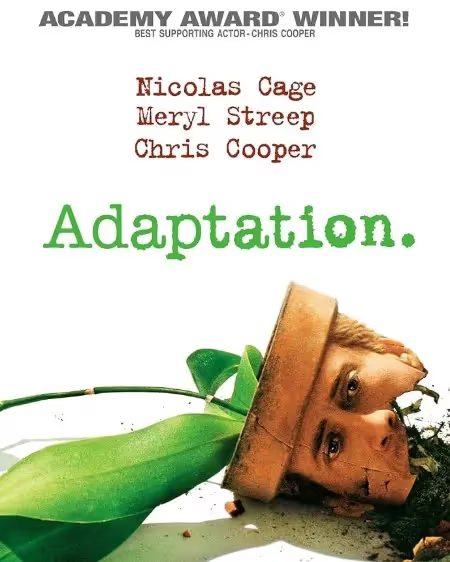
Adaptation is a film about adapting a book into a screenplay, but it’s also about adaptation in far more unsettling ways. Several stories are layered into a dense, self-referential plot where a slice of South Florida history becomes the backdrop for a screenwriter’s existential crisis about writing the very movie we’re watching. The journey isn’t just into the swamp in search of an elusive bloom, but into the minds of people desperate to “care passionately about something.”
The screenplay grows out of Charlie Kaufman’s real-life struggle to adapt Susan Orlean’s nonfiction book The Orchid Thief. Faced with the impossible task of writing a Hollywood movie about flowers, Kaufman folds his own anxiety, insecurity, and creative paralysis directly into the script, inventing a fictional version of himself trapped inside the adaptation process.
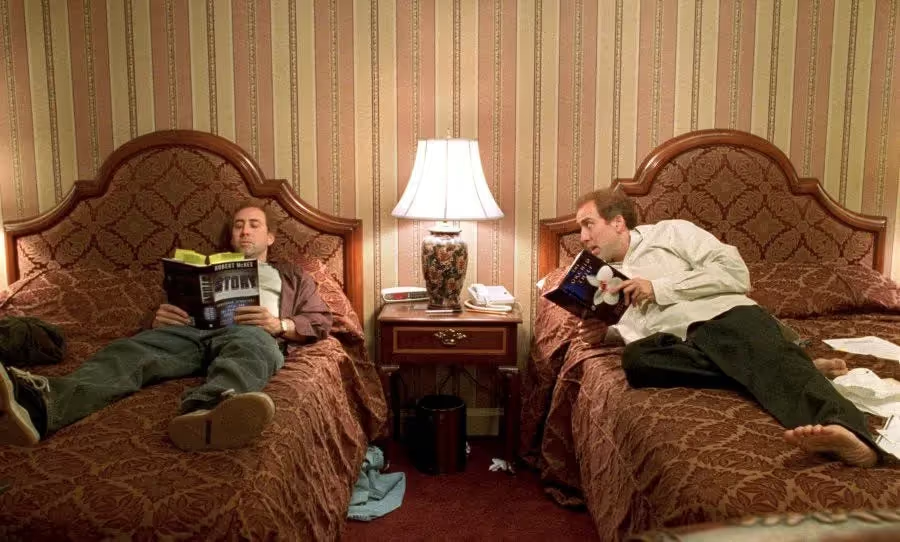
Nicolas Cage plays Charlie as a bundle of nerves and hesitation, a man crippled by self-awareness and indecision, clearly echoing the spirit of T.S. Eliot’s Prufrock. Cage also plays Charlie’s fictional twin brother, Donald, a carefree contrast who barrels confidently through life and writes formulaic Hollywood screenplays without shame or doubt. Donald adapts easily and effortlessly—but his work is hollow, predictable, and emotionally thin.
Charlie, for all his talent and ambition, is immobilized by fear. He is a master of hesitation, not adaptation. It’s only after Donald is killed off that Charlie finally breaks free, stumbling headfirst into the very clichés he tried so hard to avoid. The story spirals into a car chase, a fatal alligator attack, and a syrupy musical ending—an intentional collapse into Hollywood convention.
Yet through that collapse, Charlie finally adapts. He stops overthinking, kisses the girl, and finishes the screenplay. As “So Happy Together” plays, Charlie drives off—not into the sunset, but out of a parking lot onto Sunset Boulevard—liberated at last from writer’s block.
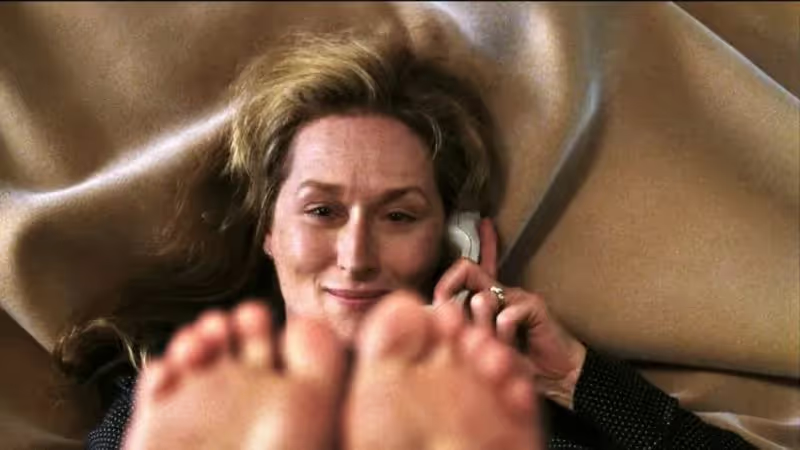
As compelling as Charlie’s internal battle is, the story within the story is even more fascinating because it’s rooted in true events that could only have happened in South Florida, home to one of the rarest flowers on Earth. John Laroche (played brilliantly by Chris Cooper) was a real Miamian arrested in 1993 for poaching ghost orchids from the Fakahatchee Strand. Susan Orlean (Meryl Streep) is the journalist who covered his court hearing and later expanded her reporting into The Orchid Thief.
The film invents a romantic relationship between Laroche and Orlean—something that never happened in real life—but much of Laroche’s notoriety as a poacher comes directly from Orlean’s New Yorker reporting, sometimes word for word. The fictional romance becomes another warped form of adaptation.

Laroche is an obsessive polymath, diving headfirst into passions only to abandon them completely without regret. In one memorable scene, he renounces fish altogether, refusing even to step into the nearby Atlantic. Orlean, by contrast, is emotionally detached, successful, and searching for meaning. She longs for “something to care passionately about,” and she finds it not in orchids themselves, but in Laroche’s uncompromising obsession with them.
Their brief connection is fueled by hallucinations, emotional desperation, and mutual projection. They adapt to each other temporarily—but the relationship cannot survive. As with so much in Adaptation, evolution comes at a cost.
Orchids are masters of adaptation, with more than 25,000 species evolved to attract specific pollinators. The ghost orchid, Polyrrhiza lindenii, discovered in 1844, is among the rarest. Found only in Southwest Florida, Cuba, and the Bahamas, it appears as little more than roots clinging to trees when not in bloom. When it flowers, it seems to float in midair.
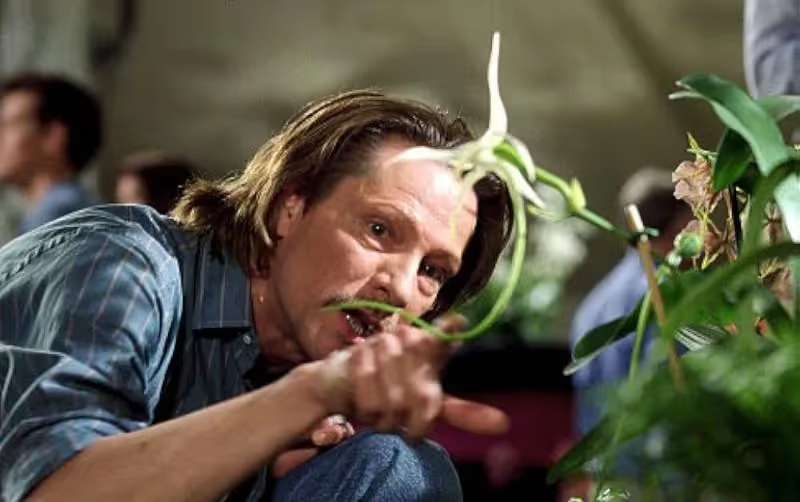
Because of its rarity and difficulty to cultivate, the real Laroche believed cloning the orchid might end the black market and preserve the species—a justification that fueled his illegal actions. Orlean quotes Laroche boasting to a Collier County judge about his unparalleled expertise, a claim not entirely unfounded. He was one of the few people capable of propagating the ghost orchid in a lab.
Laroche’s life was marked by catastrophe: Hurricane Andrew destroyed his greenhouses, a car accident killed family members, and his marriage collapsed. After Andrew, he worked with the Seminole Tribe of Florida, exploiting legal loopholes involving tribal immunity and endangered species law. In 1993, Laroche and three Seminole men were arrested for removing 136 plants from the Fakahatchee Strand. The case hinged on technicalities involving tree branches versus endangered plants, and while Laroche paid fines and returned the orchids, his greatest punishment was a six-month ban from the swamp itself.
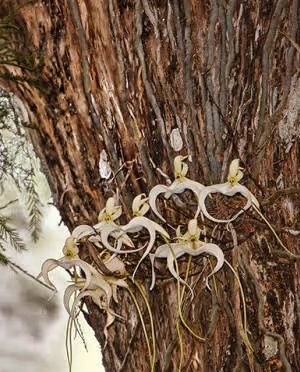
The ghost orchid remains a local celebrity. Sightings at Corkscrew Swamp Sanctuary near Naples still draw crowds, photographers, and conservationists. With only one known pollinator—the giant sphinx moth—the orchid’s survival depends on a relationship so precise it borders on miraculous.
The flower has also inspired art. Renowned Everglades photographer Clyde Butcher documented the ghost orchid in a haunting triptych at the turn of the millennium, hauling ladders and heavy equipment deep into the swamp to capture a bloom that might vanish the next day.
Seen as a whole, Adaptation uses the ghost orchid as its central metaphor: survival through change, obsession balanced against connection, and the uneasy truth that adaptation doesn’t always mean improvement. Orchids have mastered it. Humans, not so much.
Editor’s Note: Originally published on July 20, 2007. Updated in 2026 with new photography; while preserving Maria de los Angeles' original review.

Lorem ipsum dolor sit amet, consectetur adipiscing elit. Suspendisse varius enim in eros elementum tristique. Duis cursus, mi quis viverra ornare, eros dolor interdum nulla, ut commodo diam libero vitae erat. Aenean faucibus nibh et justo cursus id rutrum lorem imperdiet. Nunc ut sem vitae risus tristique posuere.
Lorem ipsum dolor sit amet, consectetur adipiscing elit. Suspendisse varius enim in eros elementum tristique. Duis cursus, mi quis viverra ornare, eros dolor interdum nulla, ut commodo diam libero vitae erat. Aenean faucibus nibh et justo cursus id rutrum lorem imperdiet. Nunc ut sem vitae risus tristique posuere.
Check out our top local tours on Miami Beach 411—no tourist traps, just the best adventures, Everglades, and more.
Book Your TourOr book your hotel through our Hotels.com partnership—it helps keep Miami Beach 411 free and independent for everyone.
Book Your Hotel

Comment disclaimer:
Some comments below originated on a previous version of MiamiBeach411.com. As a result of platform migrations, displayed comment dates may reflect import timestamps rather than original posting dates. Many comments date back to the early 2000s and capture community conversations from that time. If you have local insight, updates, or memories to share, we welcome your comments below.
This story has been part of Miami Beach conversations for decades—and it’s still unfolding. Add your voice.
Lorem ipsum dolor sit amet, consectetur adipiscing elit. Suspendisse varius enim in eros elementum tristique. Duis cursus, mi quis viverra ornare, eros dolor interdum nulla, ut commodo diam libero vitae erat. Aenean faucibus nibh et justo cursus id rutrum lorem imperdiet. Nunc ut sem vitae risus tristique posuere.
Lorem ipsum dolor sit amet, consectetur adipiscing elit. Suspendisse varius enim in eros elementum tristique. Duis cursus, mi quis viverra ornare, eros dolor interdum nulla, ut commodo diam libero vitae erat. Aenean faucibus nibh et justo cursus id rutrum lorem imperdiet. Nunc ut sem vitae risus tristique posuere.