

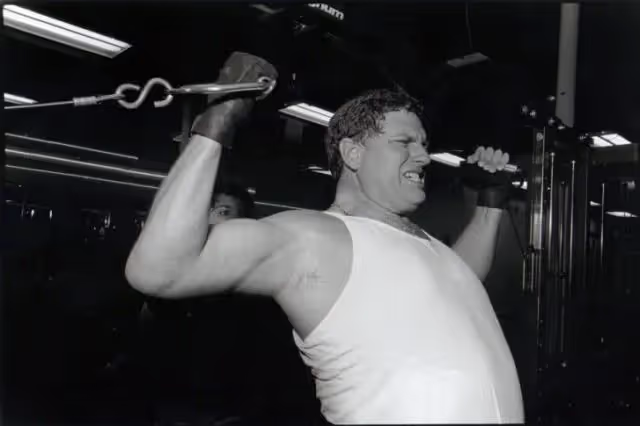
Say what you will about Alex Daoud, but the man knows how to laugh at himself. I learned this firsthand after writing a deliberately abbreviated profile of some of Miami’s most crooked and colorful politicians. Not long after it ran, I received an email from the third man on the list.
“Great article on the Top 20 Most Corrupt and Crazy Public Servants. But I believe you made a typographical mistake. I should have been listed #1 instead of #3. But I forgive you.
Your ardent reader,
Alex Daoud.”
It was then that I knew Alex Daoud, unlike a lot of people I’ve gotten emails from, had an excellent sense of humor.
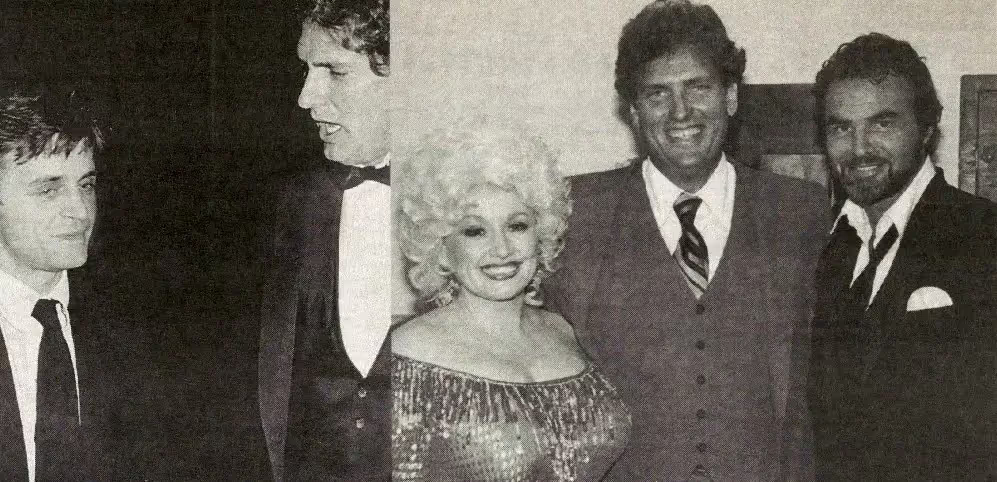
Alex invited me to meet up with him in South Beach for dinner, and, more importantly, to give me a copy of his book, “Sins of South Beach,” which chronicles the sex, violence and corruption of his time in public office. Though he has been certainly brought down to Earth after his twelve years as a Miami Beach Commissioner and Mayor by corruption and bribery convictions, the man is still an unabashed self-promoter. And no one should hold that against him; how else do you get elected mayor three times and write a successful novel?
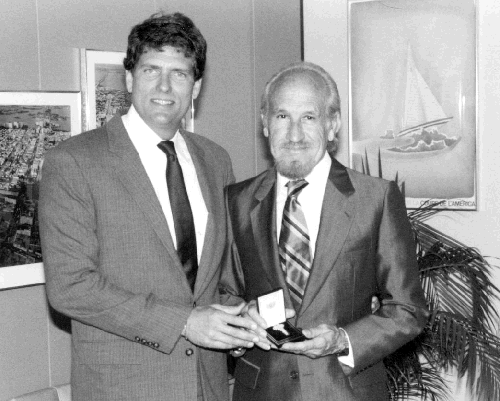
For those who are not familiar with the Miami Beach icon that is Alex Daoud, he is an actual native of the Beach who became a City Attorney in town, then a commissioner, then mayor from 1985-1991. He was the first mayor to be reelected in 20 years, and managed to be reelected twice. Somewhere along the way he might have taken a bribe or two, sold a couple of votes, and had illicit extramarital affairs with a variety of Miami’s finest women, but that is all in the past. What is the present is Alex Daoud, aspiring author living in a modest home just down the street from the apartment building he and his mother managed in what seems like another lifetime.
Alex’s voice still booms as if he were addressing City Hall or a large-scale political rally. “Matt!” he bellows into his cell phone, sounding as excited to receive a phone call form me as he might have been from Burt Reynolds or Dan Rather. “How are you?! When you getting here?!” No wonder this guy won so many votes: Call him a corrupt egomaniac and he treats you like his best friend.
He tells me to park by the Brarack Obama sign in his front yard.
“You’re not voting for McCain, are you?” he asks ma a week before the election. “He’s a great man, and it’s a shame what they did to him. But I’m a Democrat.”
Alex Daoud’s endorsement, I am convinced, is what carried our state for Obama.
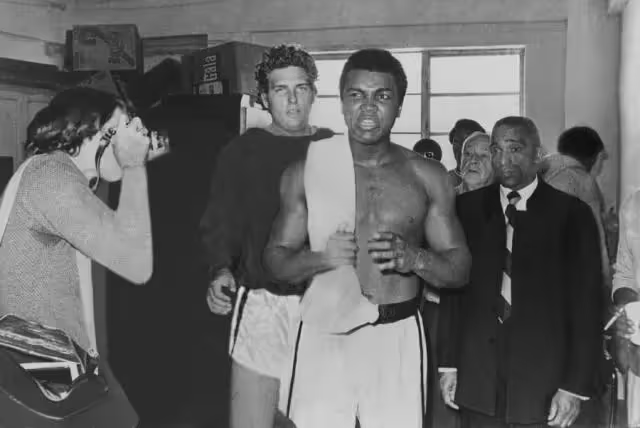
Despite being in his mid-60s now, Alex Daoud is still an imposing figure. He answers his front door, and his 6-foot 4-inch frame fills the entire entryway. He is a large man, obliviously not in as good of shape as he was in the days when he trained with Angelo Dundee and Mohammad Ali at the 5th Street Gym, but his athletic past is evident.
His office is small, but he uses every available inch of wall space to remind himself of a glorious past. There are pictures of him with Mohammad Ali, a trophy commemorating his boxing match with Miami Mayor Xavier Suarez, countless tokens of esteem from various organizations, and photos with celebrities too numerous to mention. There is also no shortage of promotional material for his book. The office is like the Alex Daoud Hall of Fame, a constant reminder of everything this resident tucked away off Lincoln Road has done for the city.
We head over to Lincoln Road, and Alex is a sharp contrast to the ever-trendier crowd that populates the pedestrian mall. Though it is Friday night, and the mall is abuzz with people wearing outfits worth more than their cars, Alex towers over them all in a white T-Shirt emblazoned with a picture of his book and some basic Adidas warm ups. After a lifetime of serving and forming Miami Beach, he doesn’t need to impress anybody.
“In the 80s, this place was all boarded up,” he says as he motions to the flourishing restaurants and shops on Lincoln Road. “It was a ghetto. You wouldn’t come down here at night. Now, it’s beautiful.”
Indeed, Daoud was instrumental in the transformation of South Beach from retirement ghetto to American Riviera. Though Miami Beach was, in the middle of the last century, a glamorous hotspot for celebrities and wealthy people, by the time he took office as a City Commissioner in 1979, it had deteriorated significantly. Matters were not helped, he contends, by the Mariel Boatlift.
Castro duped Jimmy Carter into allowing all these monsters into our city,” he says of the boatlift. “I love almost all of the Cuban people I’ve met over the years, but these guys, they weren’t Cubans. They were monsters.
“We had seniors walking the streets; they were just lambs being slaughtered by these wolves. We had people dying, old women being raped. And we couldn’t do anything because the jails were too full. We’d bring them over to Dade County Jail downtown, and they’d just release them. We lost two beautiful police officers here because of that.
I wrote ‘Sins of South Beach’ because I felt like this story needed to be told. People needed to know what was going on here.”
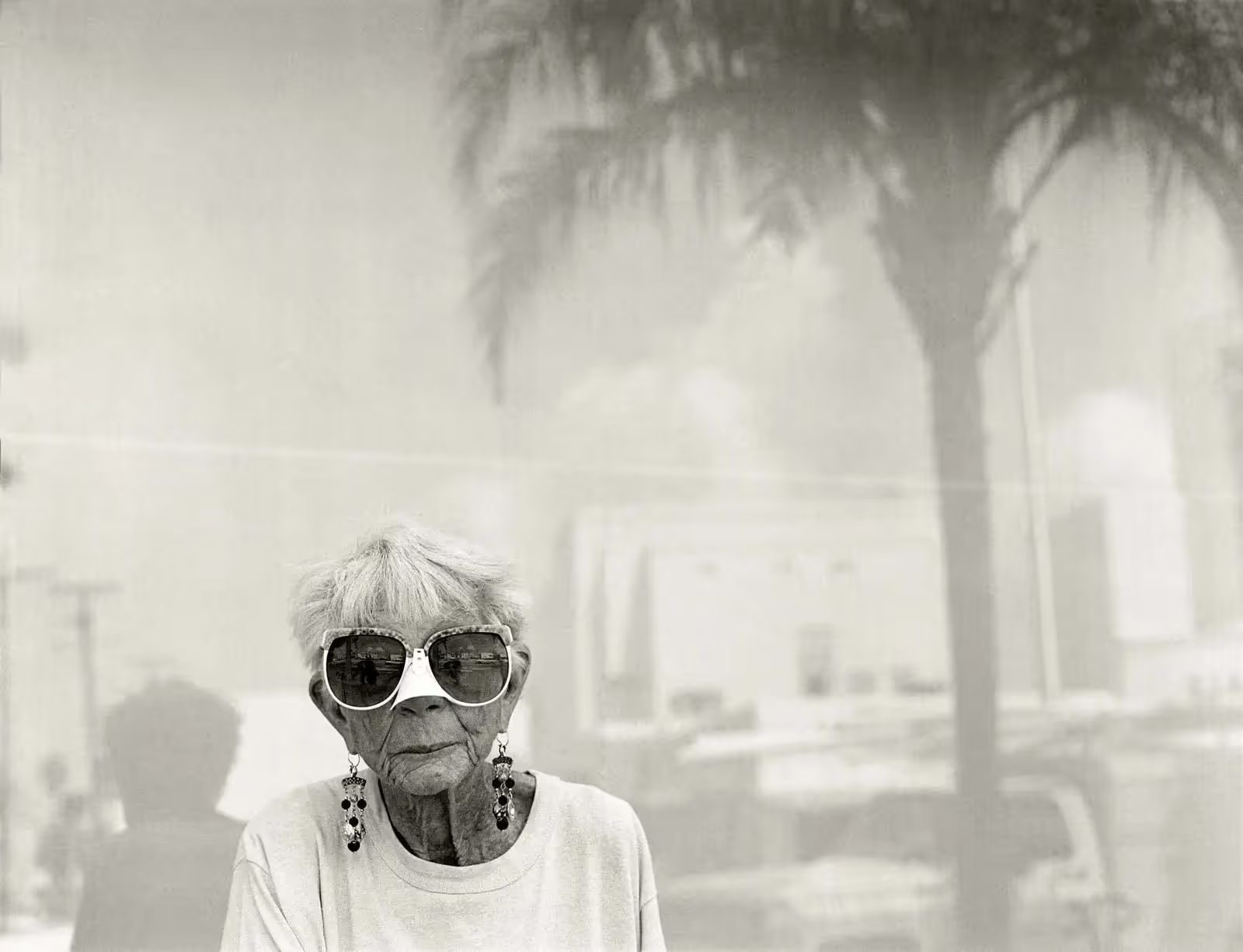
Much of the remaining population consisted of elderly Jewish residents living on fixed pensions, many of them holdovers from the city’s postwar boom, staying not by choice but because they had nowhere else to go. Daoud credits the eventual turnaround to aggressive policing and political will, though his recollections—like much of Miami’s past—are not without controversy.
But, Daoud says, he and the Miami Beach Police had their own solution to the rampant crime of the early 1980s. He called them “attitude adjustment session..” During these sessions, he and some other police officers would beat known criminals to within an inch of their lives and leave them in body bags so as not to mess up their cars when they drove them across the causeway and dumped them in Miami. They would victimize Miami Beach’s citizens again, he reasoned, so it was preemptive violence. Like “Dexter” only less dramatic and 25 years earlier.
“We would leave them over in Miami, in Overtown or in Liberty City and take their money, their belts, their shoes,” he takes a drink of water as he laughs about it. “You know what happens in those neighborhoods when you don’t have any of that?” The question is rhetorical. Anyone who knows this city knows damn well what happens.
But as brutal and inhumane as some may find such treatment, the reduction in crime was essential in bringing back Miami Beach. Once the crime was gone, then true redevelopment could begin. And perhaps without those “attitude adjustments” we would not be sitting outside at Books and Books enjoying the passers by.
Alex’s penchant for beautiful women didn’t die when he left office. Quite the contrary, he seems as well attuned to the parade of sex on a Friday night in South Beach as any of my twentysomething friends.
“Look at that, WOW!” he says as a pair or Argentine beauties stroll by in knee-high boots and expensive blouses. “I always loved the Latin women. They’re so exotic, so beautiful.” I told him I did not share his fascination, and he told me I should not be so picky.
During his term as Commissioner and Mayor, Daoud was not opposed to indulging women who thought they might enjoy his company. Despite the fact that he was married for most of that time. (One of his mistresses actually testified against him in his corruption trial)
“I’ve helped more single women in this town than welfare,” he says. “And it’s not because I’m some great magnanimous individual either.” He laughs. I told him I didn’t believe in spending money on women.
“Of course you don’t,” he answered, “you’re young and good looking. When you get old and fat like me, you will.” Unlike Alex’s prediction of my writing a New York Times Bestseller in his autograph of my book, I hope this premonition does not come true.
Despite calling himself old and fat, it doesn’t stop Alex from flirting. He asks the host at Books and Books when a certain hostess will be on, and we go inside and browse until her shift begins. As soon as she takes her post outside by the tables, he goes over, flirts with her, then asks for a table in one specific waitresses’ section. Again, we have to wait until the waitress has an open table before we can sit down. Eventually we get a table in her section, and again, Alex flirts with her throughout the meal.
The waitress, a red-haired 23 year-old from Eastern Europe, seems entertained and slightly flattered at Alex’s inquisition into her yoga practices. She kids with him and does not seem at all offended. Again, this must be why the man never lost an election: he can say things to people that make them smile, when if anyone else said it, it would probably invite a slap to the face.
After dinner we continue inside and Alex asks the store manager how “Sins of South Beach,” is selling.
“Real well,” the manager says. “A couple of people came in yesterday and asked about it. We still got it up on display. Edna Buchanan’s book isn’t on display anymore, but we still have yours up there.” Buchanan, for those unfamiliar, is a former Miami Herald crime reporter-turned novelist. Her books do well. Apparently Alex’s is doing a little better. The display will be down the next time we visit Books and Books, but the flashy cover photo of Ocean Drive awash in pink neon is still quite the effective eye grabber.
For his part, Alex Daoud seems content in writing his book and its subsequent promotion. And despite no longer ruling South Beach, he has no desire to return to public life.
“This is what I love about being a private citizen,” he says as he motions to me. “A guy calls me crooked and corrupt, and I can call him up and invite him out to dinner. When you’re in politics, you have to worry about stuff like that.”
Alex, despite having fallen from grace and gone to prison, seems happy with his life. He has two dogs, who he talks about a lot, and enjoys spending his time on the book. And while most people who stroll through Miami Beach’s vibrant nightlife have no idea who Alex Daoud is, or what he did for Miami Beach, they most certainly feel his influence. Alex ushered in the era of change that took the boards off Lincoln Road and moved coke sales from street corners to club corners. Would South Beach be what it is today without Alex Daoud? Probably not. But he is content to let the Beach go on without knowing who he is. Or, at least, he wants “Sins of South Beach” to do the talking for him.
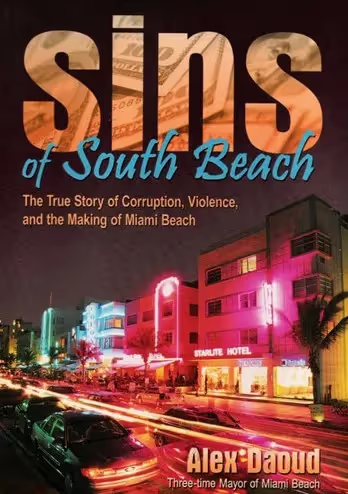
Say what you will about former Miami Beach Mayor Alex Daoud, the man cannot get enough of the spotlight. If 12 years (6 as a commissioner and 6 as mayor) as an elected official and a heavily publicized federal corruption trial were not enough, Daoud now remains in the public eye with his tell-all memoir “Sins of South Beach.” In it, the former mayor tells of the lies, corruption, sex and violence that took Miami Beach from a crime infested retirement ghetto to the American Riviera that it is today.
If you are an aficionado of South Florida history, or even the recent history of Miami Beach, you will find this book fascinating. If you have moved here recently, this book really makes you understand that South Beach was not always synonymous with celebrities and parties, but rather with old people and street crime.
Imagine an island of retirees left by their children to die on the sand. Imagine unscrupulous landlords taking advantage of their elderly tenants by illegally raising rents and keeping security deposits (ok, that happens today too). And imagine a power establishment so strong that the poor old folks had nowhere to turn. This was South Beach in the late 1970s, and the elderly needed a champion in city government to protect their rights. That champion was Alex Daoud, a Miami Beach city attorney.
During his first term, Alex was a good man working to protect the rights of the elderly in South Beach. But, as we learn in the book, power- especially power in Miami Beach, always leads to corruption. Throughout the book there is a parade of powerful and crooked individuals, ranging from Miami Beach power brokers to former mayors to presidents of large financial institutions, who approach the commissioner and then mayor about “retaining” him for his services. Theoretically this “retainer” was for his services as a lawyer. But the services actually included everything from assuring unions a prevailing wage law to getting Abel Holtz’s son on the city zoning board.
The book is somewhat depressing in that it makes you realize how the wealthy really can be above the law. It shows that even in a seemingly clean democracy like we have in America, those with enough money to influence poorly paid public officials can do whatever they want, whenever they want, to whomever they want. Those of us who live in South Florida need only look at the constant movement of the Urban Development Boundary to remind ourselves of that. But while what most of us know about government corruption is anecdotal or third hand, “Sins of South Beach” makes it all too real. It’s kinda like the difference between knowing your girlfriend is cheating on you, and having her actually tell you.
The thing about any tale of corruption is that is gets incredibly complicated. Alex Dauod does the best one can expect to explain the convoluted backdoor dealings that went on at City Hall during his tenure, but because there really aren’t any tangible transactions going on, everything is very vague. If you like mob stories, which are similarly vague and complicated, you may find this book easier to follow than I did. But when bribes are for third hand favors, it becomes difficult to remember who’s paying who to do what.
Alex Daoud names a lot of names in “Sins of South Beach.” Some of the people had already been convicted or never charged with the crimes he mentions. Others were never charged. And it is unlikely that this book will launch any sort of federal investigation into corruption charges from 18 years ago. But, as Daoud told me, he is “surprised nobody has sued (him) over the book yet.” There seem to be a lot of nefarious characters in this book, and Alex Daoud seems to be the only one who paid the price. Even one of the villainous characters in the book, Abel Holtz, has a 2nd of NE 2nd Ave. named after him in the heart of downtown Miami. This location is just 2 blocks from the Federal Courthouse where he pled guilty to a felony involving lying to a grad jury. How’s that for irony?
Another interesting aspect of the book is Daoud’s description of the rampant crime that gripped Miami Beach after the Mariel boatlift. His disdain for Castro seems to run much deeper than the typical South Florida political pandering, as he cites the duping of Jimmy Carter and the unleashing of thousands of violent criminals onto the streets of greater Miami as what made the Beach unlivable. He blames the boatlift for the slaughter of many of South Beach’s elderly residents in the 1980s, and the deaths of 2 Miami Beach police during the same time. The book also includes a graphic description of what he and the Beach cops referred to as “Attitude Adjustment Sessions,” where they would beat criminals to within an inch of their lives, put them in body bags, and dump them with no shoes, no belts, and no money in a bad part of Miami.
And of course, what tale of South Beach would be complete without sex? Much like his political career, Alex Daoud begins this book with good intentions. He has a wife he met in law school who comes to Miami Beach with him, and their marriage seems strong. Until he sleeps with a tennis pro. And as anyone who’s ever cheated knows, once you’ve done it once, it just goes on from there. Henry Kissinger once said that “Power is the ultimate aphrodisiac,” and Alex Daoud’s run through the women of Miami Beach is living proof of that. And as the book says, even a city commissioner in a relatively small city finds plenty of women willing to jump into bed with him. Two failed marriages ensued.
The sex scenes in the book are not particularly graphic, but they seem to romanticize what to the casual observer are rather tawdry affairs. In his extensive discussion of his affair with Bonnie Levin (who was the prosecution’s star witness in Daoud’s federal trial) he talks of her recruiting women for threesomes on a regular basis. Which is all well and good until he describes “making love” to a stranger that his girlfriend brought over for their mutual enjoyment. How much “making love” is really going on in your average threesome? I’m guessing there wasn’t a whole lot on longful gazing going on in the bedroom of the mayor’s mansion during these encounters.
Alex Daoud does a great job of telling the story, but in so doing he takes a lot of liberties with quotations. Much like Truman Capote was criticized for inventing conversations for “In Cold Blood,” so does Alex Daoud have dialog in this book that reads like it came from a screenplay. People explain things to each other that they obviously already know (this is presumably so the reader is clued in) and conversations take place that are, for lack of a better description, just not what people say. And given how much Alex Daoud has been through in the past 20 years, it is unlikely he remembers who exactly said what, just what the gist of the conversation was. But, much like with Capote, this doesn’t do a whole lot to detract from the book as a whole.
The book is not a quick read, as it checks in at nearly 500 pages. But if you are fascinated by South Florida history or government corruption, it doesn’t seem long at all. You take away from this book a lot about how Miami Beach operates, and how it got to be the way it is. And that is wasn’t necessarily a pretty story. Alex Daoud said he wrote this book because it was a story he felt needed to be told, and that the media only reported part of the story. The story may be a bit hard to swallow for some, but quite often the truth hurts. Especially when it’s the truth about a town full of illusion like this one.
Alex Daoud passed away in March 2025, closing the chapter on one of the most consequential and controversial mayors in Miami Beach history. His years in office helped reshape the city’s identity, pushing Ocean Drive and South Beach onto the global stage and accelerating Miami Beach’s transformation into an international cultural and tourism destination.
At the time of his death, the city offered a rare and symbolic gesture of grace, flags at Miami Beach City Hall were lowered to half-staff in his honor—an unmistakable sign that, despite past controversies, the city ultimately chose to recognize his service and contributions. In the end, Miami Beach did what it often does best: it remembered the full story, and found a way to forgive.
Editor’s Note: Originally published in 2009. Updated in 2026 with new photography; Matt Meltzer’s original writing remains unchanged.

Lorem ipsum dolor sit amet, consectetur adipiscing elit. Suspendisse varius enim in eros elementum tristique. Duis cursus, mi quis viverra ornare, eros dolor interdum nulla, ut commodo diam libero vitae erat. Aenean faucibus nibh et justo cursus id rutrum lorem imperdiet. Nunc ut sem vitae risus tristique posuere.
Lorem ipsum dolor sit amet, consectetur adipiscing elit. Suspendisse varius enim in eros elementum tristique. Duis cursus, mi quis viverra ornare, eros dolor interdum nulla, ut commodo diam libero vitae erat. Aenean faucibus nibh et justo cursus id rutrum lorem imperdiet. Nunc ut sem vitae risus tristique posuere.
Check out our top local tours on Miami Beach 411—no tourist traps, just the best adventures, Everglades, and more.
Book Your TourOr book your hotel through our Hotels.com partnership—it helps keep Miami Beach 411 free and independent for everyone.
Book Your Hotel

Comment disclaimer:
Some comments below originated on a previous version of MiamiBeach411.com. As a result of platform migrations, displayed comment dates may reflect import timestamps rather than original posting dates. Many comments date back to the early 2000s and capture community conversations from that time. If you have local insight, updates, or memories to share, we welcome your comments below.
This story has been part of Miami Beach conversations for decades—and it’s still unfolding. Add your voice.
Lorem ipsum dolor sit amet, consectetur adipiscing elit. Suspendisse varius enim in eros elementum tristique. Duis cursus, mi quis viverra ornare, eros dolor interdum nulla, ut commodo diam libero vitae erat. Aenean faucibus nibh et justo cursus id rutrum lorem imperdiet. Nunc ut sem vitae risus tristique posuere.
Lorem ipsum dolor sit amet, consectetur adipiscing elit. Suspendisse varius enim in eros elementum tristique. Duis cursus, mi quis viverra ornare, eros dolor interdum nulla, ut commodo diam libero vitae erat. Aenean faucibus nibh et justo cursus id rutrum lorem imperdiet. Nunc ut sem vitae risus tristique posuere.