


When you’ve spent decades covering Miami at its bloodiest, your perspective on the city tends to sharpen.
So when I asked Pulitzer Prize–winning crime reporter Edna Buchanan what advice she’d give people moving to Miami, her answer was simple:
Buy a gun.
Considering she’s covered more than 3,000 murders in this city, the advice tracks. If you’ve seen Miami the way Edna Buchanan has, you understand that her warning isn’t flippant — it’s informed.
And yet, despite witnessing Miami at its absolute worst, Buchanan never left. In fact, she understands better than anyone why some of us never can.

She was the author of record for the cocaine-fueled chaos that was the 1980s. She discovered the lies that led to the McDuffie riots, has reported on over 5000 deaths and has won a Pulitzer Prize. She was the lone woman in a field saturated by men, and still produced the stories none of them could. Digging a little deeper and talking to people other reporters ignored. Ensuring every story she told was the whole story.
Yet she did it all with a trademarked pinch of sarcasm that told the world “This city really is ridiculous, isn’t it?” Her most famous lead – the one that introduced me to her and is still taught in journalism schools – began a story about a man who shot up a fried chicken joint because they ran out of the food he wanted.
“Gary Robinson died hungry.”
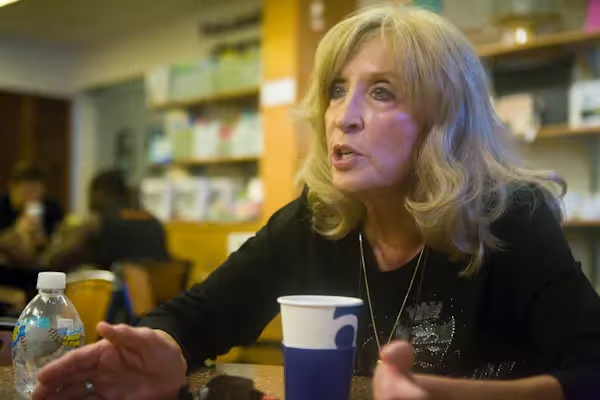
Given everything she’s seen, you might expect Edna Buchanan to have fled Miami long ago. Instead, she understands exactly why so many of us stay.
“You can leave Miami, but Miami never really leaves you,” she told us over a late breakfast at Epicure in South Beach. “I think I’d be bored anywhere else. I hate leaving Dade County—even going up to Broward or Palm Beach—because I’m afraid I’ll miss something.”
For anyone who’s tried to leave this city and failed, the feeling is familiar. When unpredictability and surrealism fuel your work, everywhere else feels flat. Miami may exhaust you, but it never bores you.
She is an inspiration to anyone who loves this city and wants to tell its stories. Her use of descriptive verbs to illustrate crimes is why I pore over every article I write, seeing if I can change “showed” to “flaunted,” or “walked” to “shuffled.”
Our own Carlos Miller credits getting his journalistic spark from Edna Buchanan.
“Her articles got me into journalism,” he said. “She made me realize there is a profession for sarcastic people with a skill for writing. It was her articles that made me realize how crazy and unique Miami can be as a city.”
“I left Miami for ten years working as a journalist in three different states and in Europe. After confirming there is no place as crazy and unique as Miami, I returned home for good. All the other cities eventually bored me.”
Her influence extends past just journalism. "Cocaine Cowboys” director Billy Corben says that his film would not have been the same without her tireless reporting.
“We are incredibly grateful to Edna for being so passionate and ethical about what she did,” he explained.
“She made it a point to incorporate as many of the murder victims as possible in our newspaper of record during that time. We’d go back in the archives to read Edna’s stories. And without her, a lot of the stories, the names, and the victims in ‘Cocaine Cowboys’ would have been vanished and gone.”
It’s not that Edna Buchanan is in love with Miami. Quite the opposite. Like every other Miamian, she is infuriated by inconsiderate neighbors. She describes the tow truck companies as “predatory,” and knows that we are a city that is perpetually raped by outside profiteers, much to the detriment of anyone who happens to be living here.
“We had the unfortunate experience of being discovered by the beautiful people,” she said.
“And the beautiful people don’t care about anything else but themselves. They’re so obsessed with themselves, so self absorbed, they don’t care what they do to the neighborhood.”
“I love Miami Beach, but I love it more for what it used to be than for what it is now.”
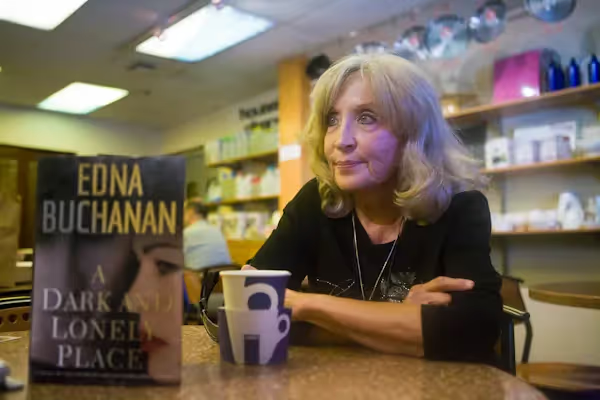
This Christmas season, Edna Buchanan is also finally telling the story she always wanted to tell. “A Dark and Lonely Place” is her new work of historical fiction, covering the lives of John Ashley and Laura Upthegrove, and their fictional 2011 descendants.
The book tells parallel tales of the legendary turn-of-the-century Florida bank robber and fugitive and a present day Miami cop. Both caught in similar unfortunate circumstances.
“I often thought about the Ashley gang when we had that perfect storm of the Mariel boatlift, the McDuffie riots and the cocaine wars. And Miami was #1 in homicide nationwide”
“I thought ‘What would they think of what Miami had become?’ And better yet, what if there were these fictional descendents of theirs were here today?”
“Here today in Miami with the same chain of circumstances, could they survive? The theme of the book is can those of us with the outlaw imprint on our DNA change our destiny? Or does it always have to end the same way?”
Buchanan admits when she started the book, she wasn’t sure of the answer.
The book follows parallel stories of good men who kill in self defense but are railroaded for murder. Both are forced into exile and fall in with dangerous companions, fleeing the law with the women they love. It’s a love story told with the Edna Buchanan style, weaving in crime and South Florida history to make the tales unique.
She covers the Ashley gang of the 1900s the same way she did the cocaine wars of the 1980s. Mostly because, as she tells it, they are essentially the same.
“The more I learned about the Ashleys, the more I realized things didn’t change,” she said. “The 80s wasn’t ‘Paradise Lost.’ It was just Miami being itself. Miami is always cyclical. And always a violent place. And those of us who forget the past are doomed to repeat it.”
Photos and video by Carlos Miller
Editor’s Note: Originally published in 2011 and updated in 2026 for clarity, while preserving Matt Meltzer’s first-hand perspective on living in Miami.

Lorem ipsum dolor sit amet, consectetur adipiscing elit. Suspendisse varius enim in eros elementum tristique. Duis cursus, mi quis viverra ornare, eros dolor interdum nulla, ut commodo diam libero vitae erat. Aenean faucibus nibh et justo cursus id rutrum lorem imperdiet. Nunc ut sem vitae risus tristique posuere.
Lorem ipsum dolor sit amet, consectetur adipiscing elit. Suspendisse varius enim in eros elementum tristique. Duis cursus, mi quis viverra ornare, eros dolor interdum nulla, ut commodo diam libero vitae erat. Aenean faucibus nibh et justo cursus id rutrum lorem imperdiet. Nunc ut sem vitae risus tristique posuere.
Check out our top local tours on Miami Beach 411—no tourist traps, just the best adventures, Everglades, and more.
Book Your TourOr book your hotel through our Hotels.com partnership—it helps keep Miami Beach 411 free and independent for everyone.
Book Your Hotel

Comment disclaimer:
Some comments below originated on a previous version of MiamiBeach411.com. As a result of platform migrations, displayed comment dates may reflect import timestamps rather than original posting dates. Many comments date back to the early 2000s and capture community conversations from that time. If you have local insight, updates, or memories to share, we welcome your comments below.
This story has been part of Miami Beach conversations for decades—and it’s still unfolding. Add your voice.
Lorem ipsum dolor sit amet, consectetur adipiscing elit. Suspendisse varius enim in eros elementum tristique. Duis cursus, mi quis viverra ornare, eros dolor interdum nulla, ut commodo diam libero vitae erat. Aenean faucibus nibh et justo cursus id rutrum lorem imperdiet. Nunc ut sem vitae risus tristique posuere.
Lorem ipsum dolor sit amet, consectetur adipiscing elit. Suspendisse varius enim in eros elementum tristique. Duis cursus, mi quis viverra ornare, eros dolor interdum nulla, ut commodo diam libero vitae erat. Aenean faucibus nibh et justo cursus id rutrum lorem imperdiet. Nunc ut sem vitae risus tristique posuere.