


“How sweet it is!” Many people remember larger-than-life Jackie Gleason as the star of The Honeymooners, an early 50’s TV classic. As Ralph Kramden, an impoverished Manhattan bus driver, he and his pal Ed Norton (Art Carney) were always up to some get-rich-quick scheme in effort to escape their lackluster tenement life in New York City.
However, not everyone knows that Gleason had a love affair with Miami, and while rat packers Jerry Lewis and Sammy Davis, Jr. get much of the credit, it was Gleason who more than anyone established the Magic City as a television hub with his “American Scene Magazine” variety show.
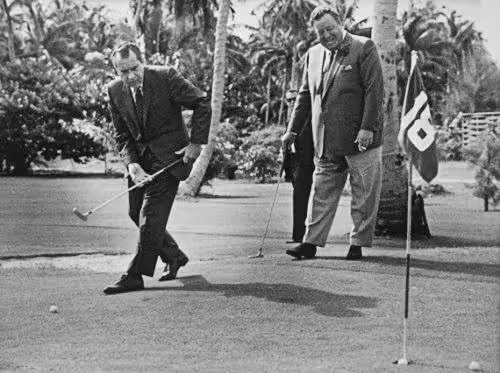
Although the program had begun its run in New York in 1962, Gleason relocated it to Miami by 1964, so he could live closer to his favorite golf course, located at the Inverrary Country Club in Lauderhill, Florida.
His show was taped each week first in New York, and later at the Fillmore Theatre in Miami Beach at 1700 Washington Avenue, which was renamed as “The Fillmore Jackie Gleason Theatre.”
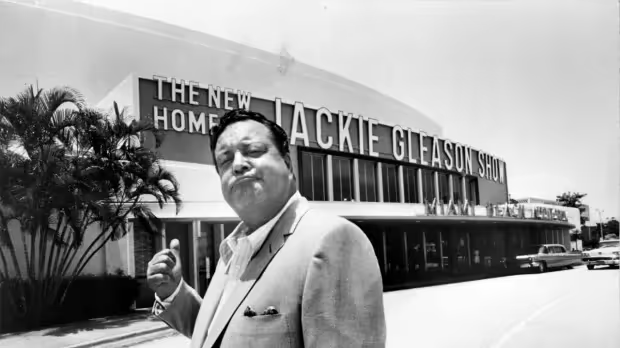
Each week, future Price Is Right announcer Johnny Olson would introduce the program with the words, “from the sun and fun capital of the world” and each night at the end of the show, Gleason would proclaim that “the Miami Beach audience is the greatest audience in the world.”
Gleason’s widow, Marilyn Taylor Gleason, now 83, continues to reside in South Florida, in Ft. Lauderdale near Port Everglades, and made a public appearance in September 2009 to commemorate the release of a new Jackie Gleason postage stamp.
(above) The Jackie Gleason stamp, released in September 2009
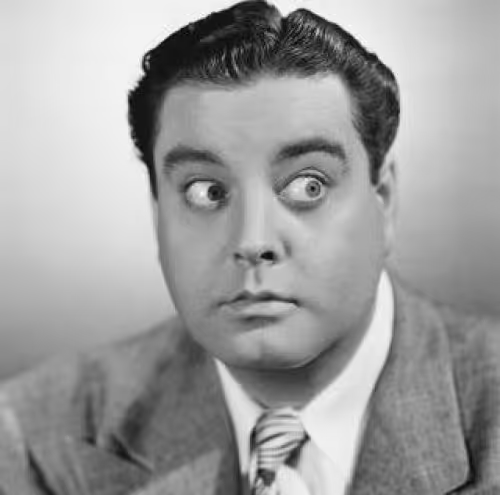
A native of Brooklyn, New York, Gleason was born on February 26, 1916 to immigrant parents from County Cork, Ireland. A high school drop out whose father had abandoned the family and whose mother passed away when he was just 19, Gleason sought a living on the Broadway stage, appearing first in a burlesque review called “Hellzapoppin” in the late 1930s. He supplemented his income selling subway tokens and later as a real life pool shark, an undertaking which would serve him well years later in his portrayal of Minnesota Fats in the 1961 film, “The Hustler.”
Gleason segued from stage into film in 1941, landing his first gig with at age 24 with “Navy Blues.” After a string of movies in 1941 and 1942, working first with Warner Brothers and later at 20th Century Fox, Gleason failed to make a lasting impression at the time with the industry brass. He acquired more attention for his all night hotel booze-ups and his racy nightclub act.

Television was where Gleason would make his mark. After landing the lead role in radio’s “The Life of Reilly” in 1949, he made his television debut a year later as the host of “The Cavalcade of Stars”—a variety show format that served as the inspiration for his later series, “The Jackie Gleason Show,” aka, “American Scene Magazine”, which ran from 1962 through 1970.
It was on “The Cavalcade of Stars” that Gleason first paired with acting partner Art Carney and the June Taylor dancers, and that one of his popular sketches would acquire a life of its own as the classic sit-com “The Honeymooners.” Later, the animated series, “The Flintstones” would borrow heavily from the former series.
During the 50’s Gleason established a successful second career as a music promoter, lending his name to several jazz instrumental albums.
After “The Jackie Gleason Show” ended in 1970, Gleason went on to appear in occasional specials which were taped at the Olympia Theater’s Gusman Center in downtown Miami.
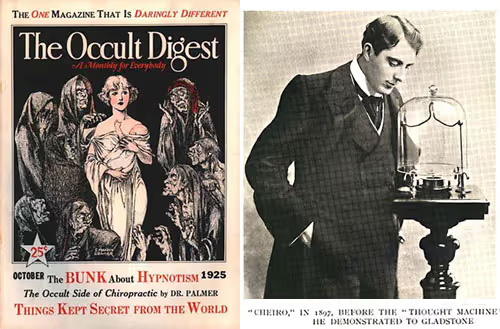
Unknown to many, Gleason developed a keen interest in the paranormal. He consulted ouija boards and was fascinated by the idea of extraterrestrial life, going so far as to build a house in the shape of a UFO, which he dubbed “The Mothership.”
Today, the University of Miami houses “The Jackie Gleason Collection”, which includes some 1700 volumes of books, journals and other publications on subjects such as reincarnation, spiritualism, witchcraft, extrasensory perception, mysticism, voodoo, demonology, mental telepathy and the afterlife.
Gleason’s second wife Audrey McKittrick claims that President Nixon took him on a secret tour of the Homestead Air Force Base where Gleason allegedly saw an alien space ship and dead extraterrestrials.
After a post-television career which included movies such as “Smokey and the Bandit”, “The Toy” and “Nothing in Common,” Gleason found himself in ill-health by 1986, suffering from colon and liver cancer, as well as thrombosed hemorrhoids.
He was hospitalized in 1986 and 1987, but eventually returned to his home in Inverrary, and passed away peacefully there on June 24, 1987. He was 71.
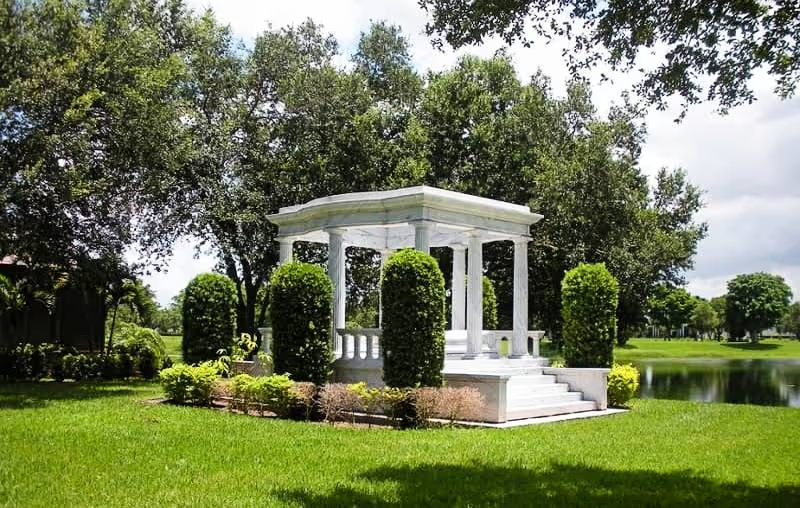
His final resting place is located at Our Lady of Mercy Catholic Cemetery in Miami (11411 NW 25th St, Doral, FL 33172). His anonymous-looking tomb is located in an outdoor mausoleum, almost unrecognizable except for the inscription of his popular catch-phrase, “And away we go!”
Gleason remains a legend in his adopted city, where his life and work have attracted throngs of visitors over the years. The lobby at the Fillmore Jackie Gleason Theatre is full of mementos from the actor’s career, and it’s perhaps there that this colorful figure from Miami’s past was able to find the immortality he’d so earnestly searched for in life.
One of the most interesting stories tied to Gleason's life in Miami is the alleged 1973 UFO incident involving President Richard Nixon. According to accounts shared by Gleason’s widow Marilyn Taylor Gleason and ufologist Larry Warren (who claimed Gleason confided in him in 1986), Nixon reportedly took Gleason to Homestead Air Force Base late one night in February 1973.
Gleason is said to have been shown what Nixon described as recovered alien bodies and extraterrestrial craft, an experience that left the comedian visibly shaken and convinced of the reality of UFOs and alien life. Whether you see it as Cold War-era myth-making or a glimpse into hidden truths, the story only adds to the legend of Jackie Gleason life here. “How sweet it is!” indeed—and away we go. 🌴👽
Editor’s Note: Originally published November 06, 2009. Updated in 2026 with new photography; Doug Eames' original writing remains unchanged.

Lorem ipsum dolor sit amet, consectetur adipiscing elit. Suspendisse varius enim in eros elementum tristique. Duis cursus, mi quis viverra ornare, eros dolor interdum nulla, ut commodo diam libero vitae erat. Aenean faucibus nibh et justo cursus id rutrum lorem imperdiet. Nunc ut sem vitae risus tristique posuere.
Lorem ipsum dolor sit amet, consectetur adipiscing elit. Suspendisse varius enim in eros elementum tristique. Duis cursus, mi quis viverra ornare, eros dolor interdum nulla, ut commodo diam libero vitae erat. Aenean faucibus nibh et justo cursus id rutrum lorem imperdiet. Nunc ut sem vitae risus tristique posuere.
Check out our top local tours on Miami Beach 411—no tourist traps, just the best adventures, Everglades, and more.
Book Your TourOr book your hotel through our Hotels.com partnership—it helps keep Miami Beach 411 free and independent for everyone.
Book Your Hotel


Comment disclaimer:
Some comments below originated on a previous version of MiamiBeach411.com. As a result of platform migrations, displayed comment dates may reflect import timestamps rather than original posting dates. Many comments date back to the early 2000s and capture community conversations from that time. If you have local insight, updates, or memories to share, we welcome your comments below.
This story has been part of Miami Beach conversations for decades—and it’s still unfolding. Add your voice.
Lorem ipsum dolor sit amet, consectetur adipiscing elit. Suspendisse varius enim in eros elementum tristique. Duis cursus, mi quis viverra ornare, eros dolor interdum nulla, ut commodo diam libero vitae erat. Aenean faucibus nibh et justo cursus id rutrum lorem imperdiet. Nunc ut sem vitae risus tristique posuere.
Lorem ipsum dolor sit amet, consectetur adipiscing elit. Suspendisse varius enim in eros elementum tristique. Duis cursus, mi quis viverra ornare, eros dolor interdum nulla, ut commodo diam libero vitae erat. Aenean faucibus nibh et justo cursus id rutrum lorem imperdiet. Nunc ut sem vitae risus tristique posuere.