


There was a time—believe it or not—when the Miami Police Department was so desperate for cops that they basically hired anyone who had a pulse and could pass a background check that wasn’t too thorough. This was the early 1980s, peak cocaine boom. Miami was the murder capital of America, the streets were soaked in blood and money, and the department doubled in size almost overnight to keep up. Standards? What standards? If you showed up without a visible nosebleed, you were probably in.
And that’s how you end up with the Miami River Cops.
On the night of July 29, 1985, eight men dressed in police uniforms stormed a fishing boat called the Mary C as it unloaded several hundred kilos of cocaine on the Miami River. At first the traffickers thought it was a legitimate raid. Then one of the “cops” shouted “kill ’em,” and everyone realized this wasn’t law enforcement—this was a rip-off with badges.
The traffickers jumped overboard. The raiders didn’t chase them. They didn’t care about arrests. They wanted the coke—350 kilos worth roughly $9 million on the street—and they took it. The next morning three bloated bodies floated up behind Jones Boat Yard. Each man still had $800–$1,000 in large bills in his pockets, designer jeans, jewelry, and guns tucked in their waistbands. They’d been executed.
It looked like another classic Miami drug rip-off. Except the raiders were real Miami police officers. They called themselves “The Enterprise.” History would call them the Miami River Cops—the most notorious gang of rogue cops ever to wear the badge in this city.
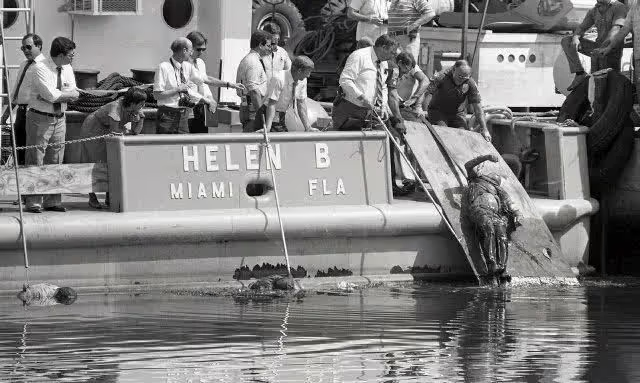
Within weeks, ten officers were under investigation. By year’s end, five were arrested. Over the next few years the probe ballooned: more than 100 Miami officers were arrested, fired, suspended, or reprimanded. Twenty were convicted and sent to prison. The scandal didn’t just expose a few bad apples—it showed how deeply the cocaine trade had corrupted the very people sworn to stop it.
The ringleaders and their crew had been shaking down dealers, stealing cash and product, then reselling the drugs themselves. They used police radios, uniforms, and authority to pull off armed robberies disguised as busts. When things went sideways—as they did on the Mary C—they killed to cover their tracks.
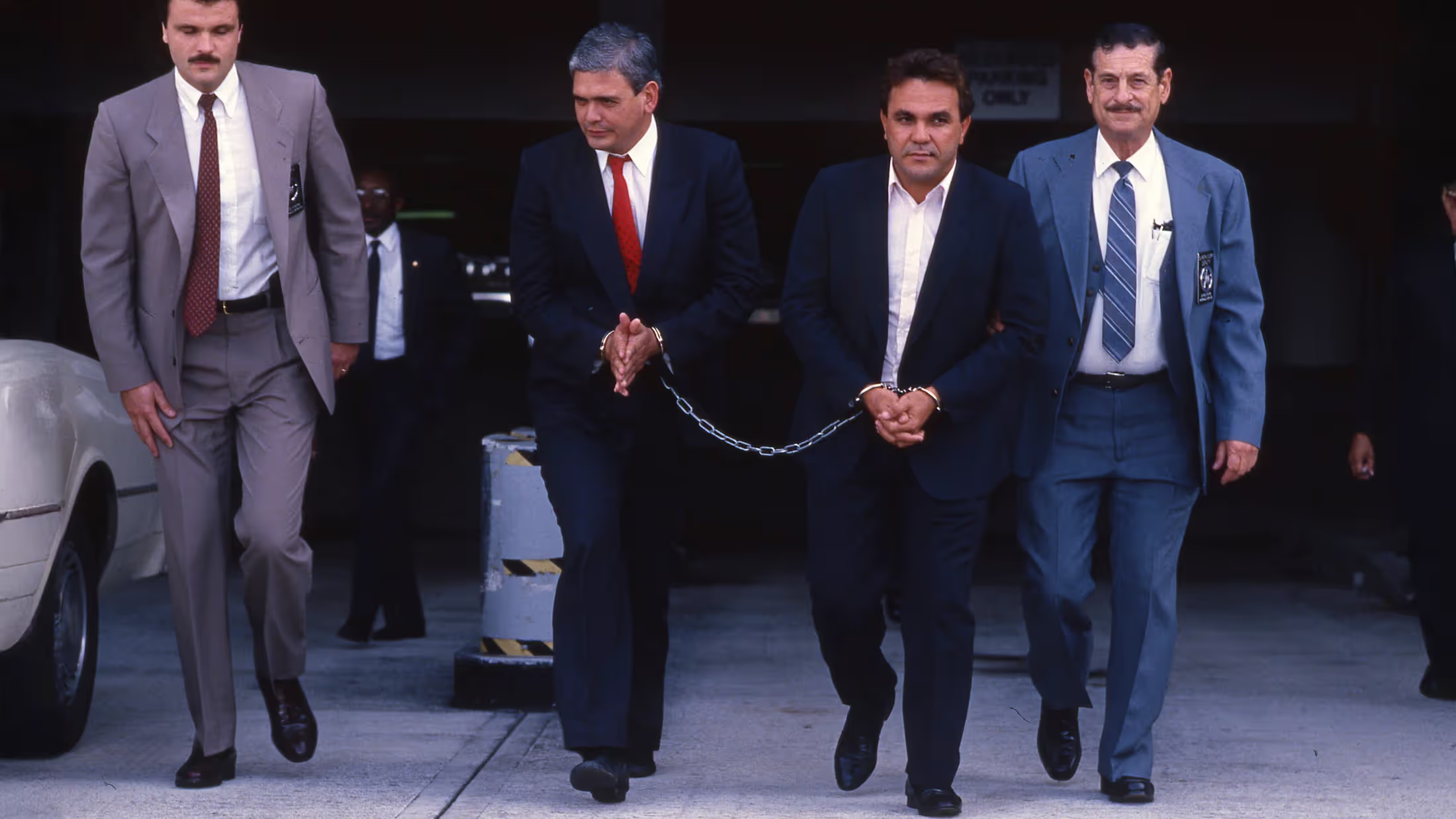
The fallout was staggering:
Most of the others served portions of their sentences and faded into obscurity. A few—like one who became a chef—tried to rebuild quietly. But the stain never really washed off.
Alex Alvarez, the Metro-Dade narcotics detective who led Centac 26 (the multi-agency task force that unraveled the ring), still remembers the disgust he felt when he realized the killers were cops.
“I was offended when I learned that they were real cops,” Alvarez told me years later, long after he’d left the force, gone to law school, and become an attorney. “It was a terrible time to be a cop. They made us all look bad.”
The Miami River Cops scandal effectively closed the book on the most violent, chaotic chapter of the city’s cocaine era—the Scarface years, the Miami Vice glamour, the machine-gun shootouts in broad daylight. The bodies stopped floating in the river quite so often. The city slowly clawed its way back from being the murder capital of America. But the scars—and the stories—never really went away.
Now a new documentary from California-based Walker Fitzgibbon, The Miami River Cops: Dirty Water, is bringing the saga back to light. The trailer (embedded above) captures the era’s frenetic energy and moral rot. If you grew up in Miami after the 1980s, or moved here later, this is the backstory you never learned in school: the moment when the line between cop and criminal dissolved completely, and the city had to confront what it had allowed itself to become.
Some things in Miami change. Some never do. But after the River Cops, we at least started pretending the badge still meant something.
As we revisit the infamous Miami River Cops scandal in 2026—now with refreshed photography and ties to modern true crime retrospectives like the documentary The Miami River Cops: Dirty Water—the legacy of this 1980s corruption saga endures, with most of the 19 convicted officers having long since served their sentences amid a wave of racketeering, drug trafficking, and conspiracy convictions that averaged over 20 years each.
Rodolfo “Rudy” Arias, who turned state's witness, served just 3.5 years before entering witness protection and later reinventing himself as a chef; Armando “Scarface” Garcia, the ringleader who evaded capture for seven years until his 1994 arrest in Colombia, was sentenced to 25 years and released in 2006;
Victor Zapata, captured shortly after Garcia, received 13 years and was freed around 2007;
Ricardo Aleman was released in 1992 but returned to prison in 2003 after a string of bank robberies, serving additional time before his presumed release by the mid-2010s.
Osvaldo Coello, handed the stiffest initial sentence of 35 years (though he served about two-thirds for good behavior, exiting around 2011), faced new federal charges in 2016 for conspiring to smuggle cocaine via powerboat, with a trial that could have meant life imprisonment if convicted—public records show no clear resolution, leaving his current status unclear amid ongoing speculation.
Other key figures like Arturo de la Vega, Armando Estrada, and Roman Rodriguez each received 30-year terms for racketeering and were likely paroled in the 2010s, while Mario Carballo and others faded from headlines after similar long stints; overall, nearly all have been released, with no major recent re-offenses reported beyond Aleman's, though the scandal's shadow lingers in discussions of police reform and Miami's cocaine-era trauma.
The comment section serves as a raw time capsule, blending nostalgia, defenses, and critiques—many from those with personal ties to law enforcement, including former Miami-Dade officers and their families, who offer insider perspectives on the era's chaos. Themes revolve around the thin line between good and bad cops, the overwhelming drug-fueled environment of 1980s Miami, and calls for balanced views beyond media sensationalism.
Standout well-written and intriguing comments include TC's gripping firsthand anecdote as a rickshaw driver in Coconut Grove, detailing a tense confrontation with Garcia over alleged brutality: "I am amazed to this day that I yelled 'that’s police brutality'... Garcia yelled back 'you’re dead. We’re going to get you'"; solamar's haunting family story of a "Miami Blue" brother who despised the force's corruption and vanished after vowing to expose it: "The day before he left us. He told my mom that he hated the force... And that he was going to be famous";
johnnyrocco's thoughtful critique as a former MPD officer, lamenting promotion biases and ongoing issues: "When they promote always from within, always shit happens... Miami MUST stop giving people command based on there race or friendship"; and Paul Hernandez, another ex-Metro-Dade officer, recalling knowing Coello and Garcia through their gym dealings: "I knew Coello and Garcia from their Gym at 42 st sw 69 ave where they would make deals from."
These posts, often defensive of individual officers' post-scandal lives or highlighting the small percentage of corrupt actors (as JB Martinez notes: "the percentage of bad cops was 1% or even less"), contrast with broader reflections on Miami's "wild wild west" days, fostering a community dialogue.
Editor’s Note: Originally published in August 2009 and updated in 2026 for clarity while preserving Carlos Miller's storytelling and investigative detail.

Lorem ipsum dolor sit amet, consectetur adipiscing elit. Suspendisse varius enim in eros elementum tristique. Duis cursus, mi quis viverra ornare, eros dolor interdum nulla, ut commodo diam libero vitae erat. Aenean faucibus nibh et justo cursus id rutrum lorem imperdiet. Nunc ut sem vitae risus tristique posuere.
Lorem ipsum dolor sit amet, consectetur adipiscing elit. Suspendisse varius enim in eros elementum tristique. Duis cursus, mi quis viverra ornare, eros dolor interdum nulla, ut commodo diam libero vitae erat. Aenean faucibus nibh et justo cursus id rutrum lorem imperdiet. Nunc ut sem vitae risus tristique posuere.
Check out our top local tours on Miami Beach 411—no tourist traps, just the best adventures, Everglades, and more.
Book Your TourOr book your hotel through our Hotels.com partnership—it helps keep Miami Beach 411 free and independent for everyone.
Book Your Hotel
.avif)

Comment disclaimer:
Some comments below originated on a previous version of MiamiBeach411.com. As a result of platform migrations, displayed comment dates may reflect import timestamps rather than original posting dates. Many comments date back to the early 2000s and capture community conversations from that time. If you have local insight, updates, or memories to share, we welcome your comments below.
This story has been part of Miami Beach conversations for decades—and it’s still unfolding. Add your voice.
Lorem ipsum dolor sit amet, consectetur adipiscing elit. Suspendisse varius enim in eros elementum tristique. Duis cursus, mi quis viverra ornare, eros dolor interdum nulla, ut commodo diam libero vitae erat. Aenean faucibus nibh et justo cursus id rutrum lorem imperdiet. Nunc ut sem vitae risus tristique posuere.
Lorem ipsum dolor sit amet, consectetur adipiscing elit. Suspendisse varius enim in eros elementum tristique. Duis cursus, mi quis viverra ornare, eros dolor interdum nulla, ut commodo diam libero vitae erat. Aenean faucibus nibh et justo cursus id rutrum lorem imperdiet. Nunc ut sem vitae risus tristique posuere.