

Morris Lapidus, born to a Jewish family that emigrated from Russia, grew up on New York’s Lower East Side, a backdrop that shaped his vision of the American Dream. Educated at Columbia University, he trained in architecture but began his career designing revolutionary retail spaces. His storefronts used wide glass facades, eliminated counter barriers, and invited customers to interact freely with merchandise—a dramatic break from traditional store design. After World War II, he also designed stores in Levittown, applying principles of openness, drama, and engagement.

Lapidus’ first major Miami Beach commission was the Fontainebleau Hotel, opened in 1954. Its quarter-circle design featured over 500 rooms, a lobby terrarium with live alligators, and playful details such as a stairway to nowhere, allowing guests to parade in style. Lapidus’ attention to theatrical detail extended to uniforms, furniture cutouts, and ceiling motifs. Critics called it “superschlock” and “boarding house baroque,” but the hotel became a cultural icon, appearing in the James Bond film Goldfinger and attracting celebrities from around the world.
Lapidus quickly followed with the Eden Roc, just steps away from the Fontainebleau. Commissioned to create “plenty of glamour” that screamed luxury, the Eden Roc hosted Elizabeth Taylor’s birthday party and Jayne Mansfield’s honeymoon, solidifying Lapidus’ reputation as Miami Beach’s architect of spectacle and fantasy.
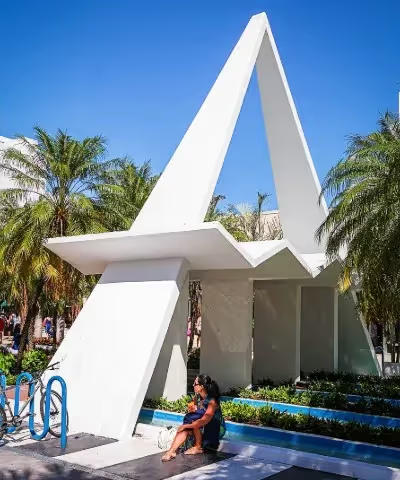
Beyond hotels, Lapidus helped shape the very streetscape of Miami Beach. His most enduring civic project was the Lincoln Road outdoor mall, which transformed a previously utilitarian downtown street into a pedestrian-friendly, open-air shopping and dining destination. By integrating sweeping curves, outdoor terraces, and carefully designed lighting, Lapidus created a seamless, immersive environment that encouraged leisure, strolling, and social interaction. The design helped redefine what a “commercial district” could be, moving it from functional space to a theatrical urban experience, and Lincoln Road remains a model for pedestrian malls nationwide.
In addition, Lapidus designed other notable Miami Beach landmarks, including the Fontainebleau Beach Club and various boutique hotels along Collins Avenue. His Miami Beach work extended beyond flamboyance; he carefully considered circulation, sightlines, and the flow of people through spaces, effectively turning hotels into destinations in themselves.
Lapidus championed principles that became his design hallmarks: eliminating corners, using sweeping lines, creating dramatic lighting effects, layering floor levels, and embracing bold colors. He called himself a Neoplasticist, combining fantasy with function. Rejecting the austerity of Bauhaus, he insisted that architecture should delight the human spirit. His hotels were cinematic sets, offering luxury, excitement, and theatrical spectacle, rather than austere or minimalist spaces.
His playful features, such as woggles, cheese holes, and beanpoles, became synonymous with his Miami Beach style—excessive, whimsical, and unapologetically fun. These design choices, once derided as kitsch, would later influence postmodern architecture across the country.
While Miami Beach remained his signature canvas, Lapidus worked nationwide, designing resorts in Las Vegas, Los Angeles, the Catskills, and New York, including The Americana, a 550-foot concrete hotel that became Manhattan’s tallest of its era. Yet Miami Beach remained the epicenter of his imagination, where he could fully realize his vision of fantasy hotels, public spaces, and pedestrian-focused streetscapes.
Although critics often derided his work, Lapidus lived to see widespread recognition. Postmodern architects embraced many of his ideas, and he resumed designing in his later years. Lapidus died in 1999 at age 98, leaving a legacy visible in the curves of Collins Avenue hotels, the terraces of Lincoln Road, and the theatricality of Miami Beach itself. His work transformed Miami Beach from a coastal getaway into a world-renowned symbol of glamour, spectacle, and the American Dream, showing that architecture could delight, entertain, and inspire.
Editor's Note: Originally published in 2002. Updated in 2026 to reflect the most current information.

Lorem ipsum dolor sit amet, consectetur adipiscing elit. Suspendisse varius enim in eros elementum tristique. Duis cursus, mi quis viverra ornare, eros dolor interdum nulla, ut commodo diam libero vitae erat. Aenean faucibus nibh et justo cursus id rutrum lorem imperdiet. Nunc ut sem vitae risus tristique posuere.
Lorem ipsum dolor sit amet, consectetur adipiscing elit. Suspendisse varius enim in eros elementum tristique. Duis cursus, mi quis viverra ornare, eros dolor interdum nulla, ut commodo diam libero vitae erat. Aenean faucibus nibh et justo cursus id rutrum lorem imperdiet. Nunc ut sem vitae risus tristique posuere.
Check out our top local tours on Miami Beach 411—no tourist traps, just the best adventures, Everglades, and more.
Book Your TourOr book your hotel through our Hotels.com partnership—it helps keep Miami Beach 411 free and independent for everyone.
Book Your Hotel


Comment disclaimer:
Some comments below originated on a previous version of MiamiBeach411.com. As a result of platform migrations, displayed comment dates may reflect import timestamps rather than original posting dates. Many comments date back to the early 2000s and capture community conversations from that time. If you have local insight, updates, or memories to share, we welcome your comments below.
This story has been part of Miami Beach conversations for decades—and it’s still unfolding. Add your voice.
Lorem ipsum dolor sit amet, consectetur adipiscing elit. Suspendisse varius enim in eros elementum tristique. Duis cursus, mi quis viverra ornare, eros dolor interdum nulla, ut commodo diam libero vitae erat. Aenean faucibus nibh et justo cursus id rutrum lorem imperdiet. Nunc ut sem vitae risus tristique posuere.
Lorem ipsum dolor sit amet, consectetur adipiscing elit. Suspendisse varius enim in eros elementum tristique. Duis cursus, mi quis viverra ornare, eros dolor interdum nulla, ut commodo diam libero vitae erat. Aenean faucibus nibh et justo cursus id rutrum lorem imperdiet. Nunc ut sem vitae risus tristique posuere.