


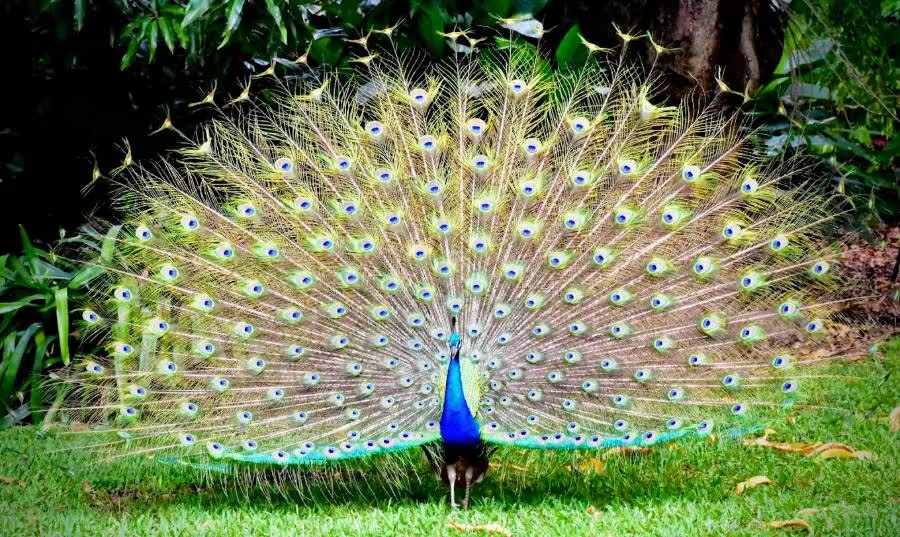
Bustling South Beach has its charms—compact walkability and near-instant access to just about anything you could desire—but the price for its convenience is a lot of traffic, cement, testosterone, and a cacophony of noises. Thus, natives and extended vacationers alike learn to appreciate the value of a day in the country!
Miami’s fast-paced reputation as “Manhattan with palm trees” may be its most recognizable image. But just a few miles south of the beach, you’ll find a very different vision of the Magic City—the way it once was. Think banyan-shaded paths, a subtropical jungle canopy, and the possibility of spotting wild crocodiles, manatees, and even peacocks roaming freely.
Judging from recent trends, one might assume that it’s necessary to flock to North Carolina to accomplish this feat—but take heart: if you want to go searching for your heart’s desire, you can find it right in your own back yard—by taking a journey down Old Cutler Road…
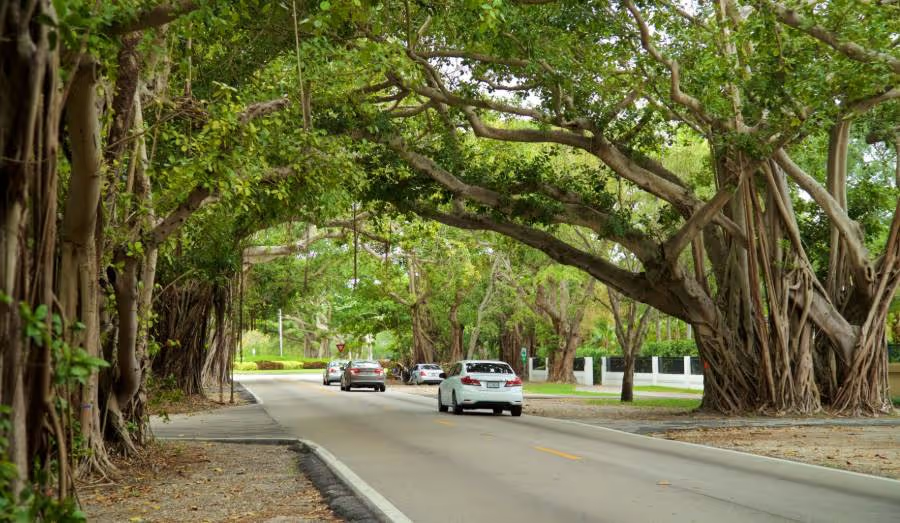
The 95 fizzles out just south of downtown and becomes the no-less harrowing US 1. Impatient soccer moms whiz around you in their SUVs; strip malls, billboards, and office buildings define the perimeter. However, if you hang a left at LeJeune Road and continue for a few blocks, you’ll begin to feel like you’re in Jurassic Park in no time. There’s a traffic circle up ahead; once you arrive, you’ll know you’ve made it to the Old Cutler Zone.
The meandering two-lane highway traverses what could easily pass for the South American jungle; with a little imagination, the enthusiastic squirrels pass for branch-hopping howler monkeys. Overhead, banyans canopy the roadways, shading a journey past secluded estates with high, vine-covered stucco walls, behind which lurk the homes of drug lords, exiled dictators…and Madonna; ever-flowering bougainvillea, bromeliads, and other myriad tropical delights pique your senses as this serene back-road draws you along its route, which leisurely winds its way southward along the coastal ridge.
Built between 1916 and 1919, it was originally known as the Ingraham Highway (and sections still are), uniting the communities of Miami, Coconut Grove, Cutler, and Homestead, before coming to its end in the Everglades. The advent of US 1 was undoubtedly a welcome event, as it succeeded in diverting the masses away, ensuring that this route would remain a veritable time-capsule into what life was once like in Miami. Here’s a bird’s-eye view!
Although it could well be said in this instance that the journey is the destination, there are nonetheless some memorable points of interest along the way. Here are but a few of them:
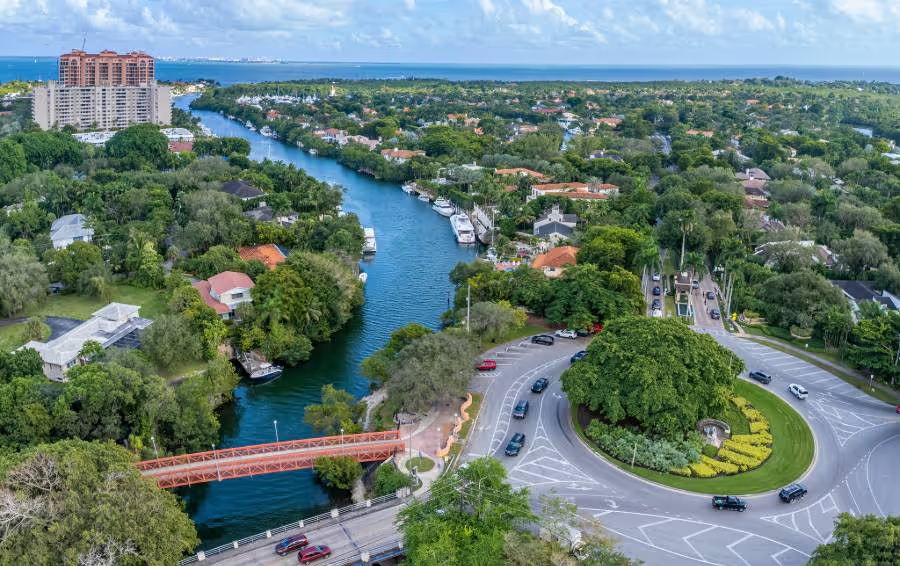
Possibly one of the most picturesque views along this route, Cocoplum Circle is located just beyond a stunning palm-shaded canal. Boats rest along its edges, moored to docks behind grand estates. It’s a great spot to hang out for a few minutes and take in the beauty; perhaps you’ll even spy a manatee. This locale has not escaped the notice of the celebrity set: Sylvester Stallone’s estate is one of the many which abut this postcard-perfect waterway. Madonna’s one-time home is just a stone’s throw away.
This verdant roundabout marks the convergence of a few of Miami’s most beautiful drives: Sunset Drive, Cocoplum Lane, LeJeune Road, and Old Cutler Road. After your scenic moment, continue around the circle until you see the sign for Old Cutler Road.
Once you’ve gotten your fill, hop back in the car and continue along your journey along the enchanted drive. Two miles later you’ll find yourself at the entrance of one of Miami’s favorite leisure destinations…
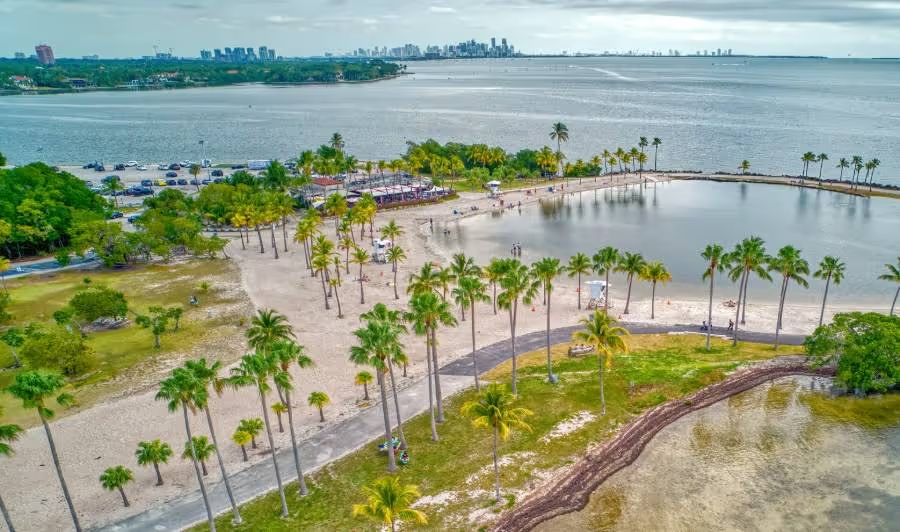
The uninitiated might imagine this to be a spot where you can relax on a rope sling, but in South Florida, the term “hammock” also refers to an area of high ground in a somewhat marshy or swampy surrounding. And that describes Matheson Hammock (9610 Old Cutler Road, Miami, 305-665-5475), Miami’s oldest park, quite aptly. As you enter the park, there is a beautiful grassy meadow off to the right, complete with a scenic pond with belly-flopping iguanas, some mangroves, palms, and a few hardwood trees. To the left are mangroves that line the canals which surround the edge of Biscayne Bay. Continue along the road for about half a mile and you’ll come to the park office, where you’ll be charged admission. (Note: Parking is now $7 weekdays, $10 weekends/holidays—up from the $4 in 2008; after certain hours, it may be free or reduced—check signs or the site.)
There isn’t much tree cover at this point, only a convergence of mangroves, which tend to be rather short and squatty, and not very shady (unlike everything else in this town). Follow the loop around and you’ll pass through various parking lots. Off to the left, there is usually a horde of local fishermen, casting their reels off into Biscayne Bay. Beyond them is a dazzling view of the skyline of Miami. Notwithstanding, the feature this park is most famous for is its coconut-palm-lined lagoon.
Leave your Gilligan fantasies at home, though; this one is a little murkier and full of kids! Behind it is the Noma Beach at Redfish, a popular local restaurant.
Surrounding all of this are nature paths, providing ample views of the native flora and fauna. Some of those closest to the water’s edge are often impassable, however, due to the mud and abundance of garbage strewn about in several directions. Before you lose all hope in humanity, however, keep in mind that much of this is no doubt the handiwork of some picnic-raiding raccoons.
For me, ironically enough, the best part of this park was the free part—the meadow near the entrance where the iguanas roam. You may also encounter some frisky blue crabs…
A stone shelter makes an intriguing landmark; its accessible roof provides an opportunity to survey the surroundings.
This is an ideal place for a picnic, as the many tables and shelters attest. And just beyond them, through the trees, you can spy the next stop on the itinerary:
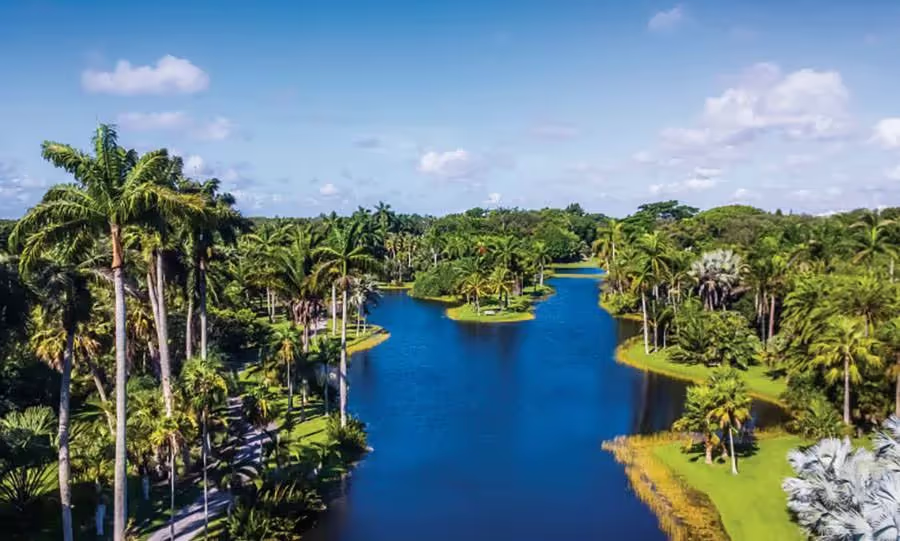
Fairchild Tropical Botanic Garden (10901 Old Cutler Road, Miami, FL, 305-667-1651) —recently rated by the Miami Herald as a “top Florida wonder”—is the largest tropical botanical garden in the United States, and is one of Miami’s most scenic attractions—and home to the only outdoor tropical rainforest in the continental US. Its beauty is unparalleled anywhere else in Florida, and quite possibly, the country.
First established in 1936 by plant enthusiasts David Fairchild and Robert H. Montgomery, the Gardens first opened their doors to the public in 1938.
If tackling this 83-acre paradise on foot in the blazing Florida sun seems too daunting a task, there is a free tram which will take you on a full tour of the exquisite surroundings.
While there, be sure to sample its butterfly garden, guided walking tours, greenhouse, and varied eco-environments. In addition, there are classes, tropical-plant themed festivals, and the garden also functions as one of the leading centers in palm research and conservation.
While the normal admission is now around $25 for adults (higher than the $20 in 2008), with reduced rates for seniors, students, and children (kids under 3 free), look for any ongoing perks like early member access or discounts—check their website for the latest. (No more universal "pay what you wish" on the first Wednesday, but occasional specials apply.)
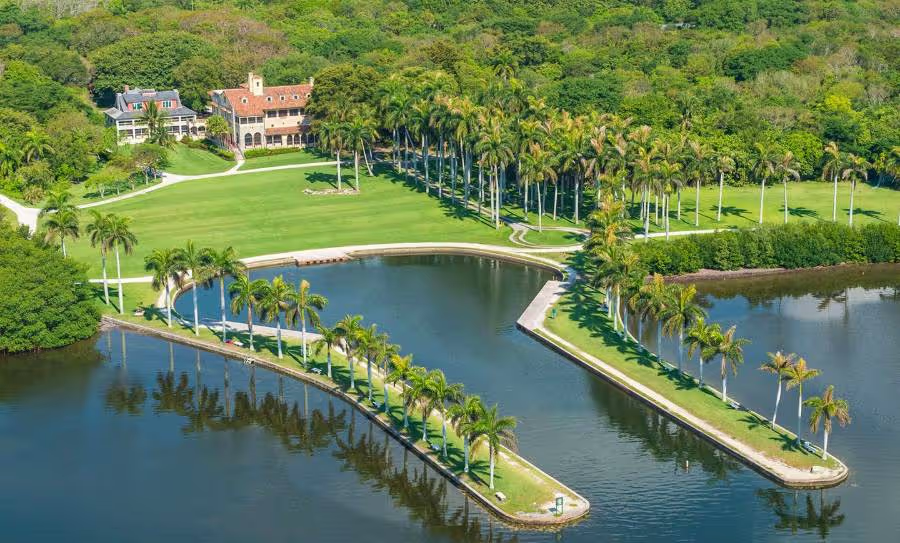
Meander further along Old Cutler a few more miles and you can experience what it was like to live the good life in the early 20th century.
The Charles Deering Estate may not attract the crowds of its more popular rival, Vizcaya—but that works in its favor. Here you’ll find a dazzling three-story stone mansion that looks like it was brought over stone by stone from the South of England. It sits alongside a less flashy wooden cottage with a screened-in porch, overlooking a group of islands off in the bay. The 444-acre grounds can be toured in groups or individually, and it’s very much a hands-on affair.
A whimsical well-manicured garden greets you when you first walk through the gate.
Various paths take you through a variety of ecosystems; there is an elevated wooden trail that leads through a mangrove swamp on one side.
On the far side of the estate is another nature walk through what very well may be the last remaining hardwood tropical hammock in the contiguous US.
When I visited, I had the good fortune of spotting some manatees frolicking near the dock. They splashed and cavorted for some time, unnoticed by a nearby group of schoolkids.
Charles Deering was a Maine native born in 1852, who, like the rest of us, fell in love with Florida and made it his home. Millionaire businessman, philanthropist, and art collector, his attention to detail is still evident in the architecture and décor today.
Though a tour of the grounds will make you feel as though you’d been transported back to its heyday between 1916 and 1927, the estate was actually devastated by Hurricane Andrew in 1992. Most of what you see today was tediously rebuilt, and was only completed in the year 2000.
For a very reasonable admission (now $18 for adults 15+, $10 for youth 4-14, $16 for seniors/military/veterans, free for 3 and under; parking free), you can tour the homes and grounds, take a butterfly hike, and commune with ghosties galore. For an additional fee, you can travel by canoe out to nearby Chicken Key.
The estate also functions as a small conference center for groups who appreciate Deering’s own pastimes: botany, history, nature conservation, fine arts, rare books, and wine—making this feel a world away from the madcap pace of Miami.
After you finish at the Deering Estate, you have the option of returning to civilization via US 1, or back-trekking up Old Cutler Road. If you do opt for the latter, be sure to follow it past Cocoplum Circle this time, and into the city of Coconut Grove, where you can shop the shops at Mayfair or visit CocoWalk, an elaborate outdoor mall. You’ll also find some unforgettable bistros and can take a stroll to the nearby marina—just in time for sunset!
Miami is a wonderful mix of old and new, of spectacles both man-made and natural, and there is perhaps no better way to take it all into perspective than this peaceful tour of Old Cutler.
Driving down Old Cutler Road remains a timeless escape in 2026, with its banyans and estates largely unchanged—though watch for ongoing improvements like wider pedestrian and bike bridges along the nearby Old Cutler Trail. Traffic circles and roundabouts added in recent years help flow, but the serene, shaded vibe endures.
This stretch of road is still one of Miami's best-kept secrets for a true "step back in time."
Editor’s Note: Originally published October 09, 2008. Updated in 2026 with new photography; Doug Eames’ original writing remains unchanged.

Lorem ipsum dolor sit amet, consectetur adipiscing elit. Suspendisse varius enim in eros elementum tristique. Duis cursus, mi quis viverra ornare, eros dolor interdum nulla, ut commodo diam libero vitae erat. Aenean faucibus nibh et justo cursus id rutrum lorem imperdiet. Nunc ut sem vitae risus tristique posuere.
Lorem ipsum dolor sit amet, consectetur adipiscing elit. Suspendisse varius enim in eros elementum tristique. Duis cursus, mi quis viverra ornare, eros dolor interdum nulla, ut commodo diam libero vitae erat. Aenean faucibus nibh et justo cursus id rutrum lorem imperdiet. Nunc ut sem vitae risus tristique posuere.
Check out our top local tours on Miami Beach 411—no tourist traps, just the best adventures, Everglades, and more.
Book Your TourOr book your hotel through our Hotels.com partnership—it helps keep Miami Beach 411 free and independent for everyone.
Book Your Hotel

Comment disclaimer:
Some comments below originated on a previous version of MiamiBeach411.com. As a result of platform migrations, displayed comment dates may reflect import timestamps rather than original posting dates. Many comments date back to the early 2000s and capture community conversations from that time. If you have local insight, updates, or memories to share, we welcome your comments below.
This story has been part of Miami Beach conversations for decades—and it’s still unfolding. Add your voice.
Lorem ipsum dolor sit amet, consectetur adipiscing elit. Suspendisse varius enim in eros elementum tristique. Duis cursus, mi quis viverra ornare, eros dolor interdum nulla, ut commodo diam libero vitae erat. Aenean faucibus nibh et justo cursus id rutrum lorem imperdiet. Nunc ut sem vitae risus tristique posuere.
Lorem ipsum dolor sit amet, consectetur adipiscing elit. Suspendisse varius enim in eros elementum tristique. Duis cursus, mi quis viverra ornare, eros dolor interdum nulla, ut commodo diam libero vitae erat. Aenean faucibus nibh et justo cursus id rutrum lorem imperdiet. Nunc ut sem vitae risus tristique posuere.