



This question pops up in the forum, every know and then. Thanks to Mom and Dad, I’ve been a Miami beach-goer for as long as I can remember. If you ask me, the only sharks you really need to watch out for here are the two-legged kind: the ones who’ll love ya and leave ya, sell you a lemon car, or strip your pockets in a shady real-estate deal.
Never mind the sharks—what about gators and crocodiles? In Florida, way more people hit the beach than the swamp, so your odds of getting nabbed by an alligator are lower than a shark bite. But if it does happen, escape is less likely. Between 1948 and 2005, Florida recorded 351 gator attacks with 17 fatalities; meanwhile, 509 shark attacks resulted in just 8 deaths.
It almost never fails: head to the beach on a balmy summer day in Miami, and someone will drop a Jaws reference. Yesterday was classic—a kid (born well after the 90s) hummed the iconic two-note theme just to spook his sister. Minutes later, a mom yelled to her little one leaping into the surf: “Don’t go too deep—there are sharks!”
Even I’m not immune. I was swimming an hour before dusk in about 4 feet of water near shore when a school of bait fish zipped by in panicked formation. “Maybe I shouldn’t get between someone’s dinner,” I thought. Then common sense kicked in: what self-respecting adult shark would chase tiny fish this close to shore in broad daylight? A jack crevalle? Sure. A shark? Nah.
But then again… maybe one’s tailing the jack…
Jaws (1975) left such a scar on our collective psyche that even decades later, it’s the first thing people think of when they see fins—or even just waves. Peter Benchley, the novel’s author, later regretted the hysteria his story created and became a passionate shark conservation advocate.
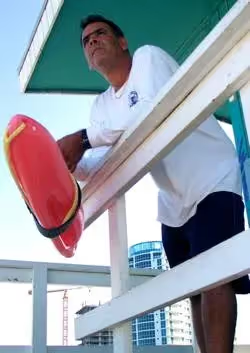
Is the shark fear really warranted in Miami Beach? Lifeguard Armando Piedra—a 10-year veteran—doesn’t think so. When asked about sharks, he winks and grins: “Sharks? What sharks? The only sharks on Miami Beach are on the sand!”
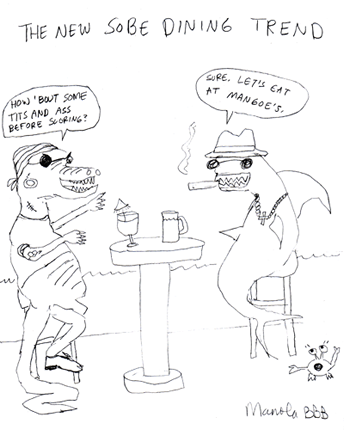
Only a girls gets the joke. Armando used to work South Beach but now enjoys mid-beach shifts at 41st Street, where the vibe is laid-back instead of “trying to get laid.”“South Beach is too crazy. Too many people,” he said matter-of-factly.
In a decade on the job, he says he’s never seen a fin in the waves—but he’s rescued 10 swimmers from rip currents this year alone. That’s 10 potential drownings prevented by one lifeguard.“I’d be way more worried about riptides than sharks,” he added. “Also, sea lice are very annoying—they stick to your bathing suit.”
The International Shark Attack File (ISAF) from the University of Florida backs him up. In Miami-Dade County, the drive from the airport to your hotel is statistically riskier than a casual swim. Humans behind the wheel cause far more harm than opportunistic fish, yet nobody panics about buckling up the way they do about dorsal fins.
Still, millions splash in our waters every year, and unprovoked shark attacks remain extremely rare.
The odds of an unprovoked shark attack are about 1 in 11.5 million, per ISAF. For context, you're more likely to be injured by a vending machine than a shark. Most bites occur during surfing or board sports, and serious incidents are outliers—often due to mistaken identity in murky water.
Other risks like jellyfish stings, sunburn, and even sand hole collapses (16 U.S. deaths 1999–2006 vs. 12 from sharks) outpace animal attacks.
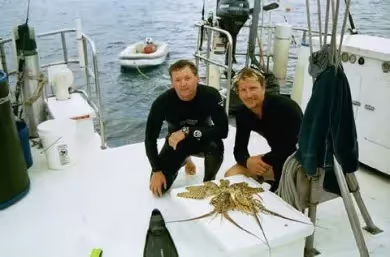
Sometimes the odds catch up. Mike Beach, president of RJ Diving Ventures, experienced diver, sailor, and underwater archaeologist, was feeding fish on a Bahamas dive in July 1996 when a reef shark latched onto his calf—requiring 400 stitches and a year of rehab.
Mike had fed sharks recreationally many times before. “I’ve got hundreds of photos of sharks,” he said. “But you develop complacency. There were 15 sharks around me; I was pushing them away. It went for my muscles to disable me—like it would any fish.”
He hasn’t fed sharks since. “I recognize it’s not the shark’s fault. I was the antagonist. I was in their world.”
Still, Mike dives regularly from Miami Beach Marina and doesn’t think locals should fear sharks. “Sharks generally don’t attack—they’re driven to alternate food sources.”
Mike’s calm encounter with a 12-foot tiger shark highlights a point: “The word ‘shark’ has such a negative connotation—it should be eliminated. Call them by their scientific name: elasmobranch.”
As a former angler, my tips for safe swims:
And remember: the drive home is statistically riskier than the water.
Florida is home to both American alligators (common in freshwater) and American crocodiles (found in saltwater areas like Biscayne Bay). Attacks are infrequent, but when they occur, they can be serious.
Alligator Attacks (Florida Fish and Wildlife Conservation Commission data):
Crocodile Attacks:
I was on the Everglades tour a while back with our guide, Gus Moore. As we were crusing in the bus down SW 8th Street, he told us this story about an alligator attack at the Miccosukee Casino:
We are now approaching the Miccosukkee Native America Casino, which is where the last human fatality caused by an alligator took place. In November 2007, a Mr. Husto Padron decided he was going to spend his Friday night breaking into cars parked at the casino. After being spotted by the Native American Police, Mr. Padron took to running and jumped the fence and swam into the retention pond out front. However, Mr. Padron failed to read the "Beware of alligators" sign, and there was a 9 foot gator waiting for him. Mr. Padron was last seen in the jaws of the beast being pulled underwater. His body was never fully recovered.
And speaking of Gus and ignoring warning signs, here’s another story about the time he didn’t pay attention and nearly went for a swim with a crocodile.
Bottom line: Respect Florida’s wildlife, follow posted warnings, and enjoy the water safely—the real risks are the everyday ones, not the ones with teeth.
Note (2026 Update): Shark fears persist thanks to viral videos and media, but stats haven’t changed much—attacks remain rare (Florida averages 20–30 unprovoked bites/year, almost all minor). Riptides, lightning, boating accidents, and rip currents continue to be far deadlier. Miami Beach lifeguards still prioritize those threats, and beach flags (double red = no swimming) save lives daily. Sharks are apex predators doing their thing—respect them, don’t panic. Swim smart, enjoy the beautiful water, and leave the real dangers to the statistics.
Editor’s Note: Originally published February 11, 2011. Updated in 2026 with new photography; while preserving Maria de los Angeles' original story.

Lorem ipsum dolor sit amet, consectetur adipiscing elit. Suspendisse varius enim in eros elementum tristique. Duis cursus, mi quis viverra ornare, eros dolor interdum nulla, ut commodo diam libero vitae erat. Aenean faucibus nibh et justo cursus id rutrum lorem imperdiet. Nunc ut sem vitae risus tristique posuere.
Lorem ipsum dolor sit amet, consectetur adipiscing elit. Suspendisse varius enim in eros elementum tristique. Duis cursus, mi quis viverra ornare, eros dolor interdum nulla, ut commodo diam libero vitae erat. Aenean faucibus nibh et justo cursus id rutrum lorem imperdiet. Nunc ut sem vitae risus tristique posuere.
Check out our top local tours on Miami Beach 411—no tourist traps, just the best adventures, Everglades, and more.
Book Your TourOr book your hotel through our Hotels.com partnership—it helps keep Miami Beach 411 free and independent for everyone.
Book Your Hotel

Comment disclaimer:
Some comments below originated on a previous version of MiamiBeach411.com. As a result of platform migrations, displayed comment dates may reflect import timestamps rather than original posting dates. Many comments date back to the early 2000s and capture community conversations from that time. If you have local insight, updates, or memories to share, we welcome your comments below.
This story has been part of Miami Beach conversations for decades—and it’s still unfolding. Add your voice.
Lorem ipsum dolor sit amet, consectetur adipiscing elit. Suspendisse varius enim in eros elementum tristique. Duis cursus, mi quis viverra ornare, eros dolor interdum nulla, ut commodo diam libero vitae erat. Aenean faucibus nibh et justo cursus id rutrum lorem imperdiet. Nunc ut sem vitae risus tristique posuere.
Lorem ipsum dolor sit amet, consectetur adipiscing elit. Suspendisse varius enim in eros elementum tristique. Duis cursus, mi quis viverra ornare, eros dolor interdum nulla, ut commodo diam libero vitae erat. Aenean faucibus nibh et justo cursus id rutrum lorem imperdiet. Nunc ut sem vitae risus tristique posuere.