


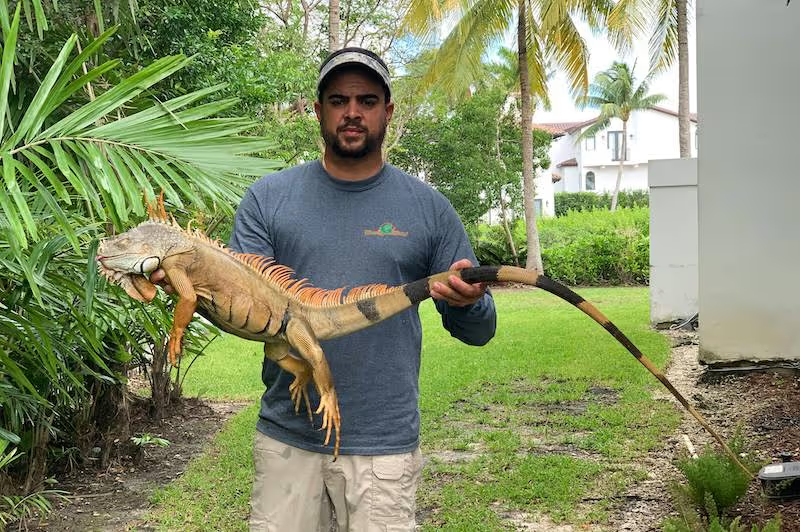
Last week I wrote about hurricanes. The week before that, it was pythons taking over the Everglades. Needless to say, a few readers were spooked. So this week, I thought I’d tackle a subject a little nearer and dearer to our collective hearts: the abundance of adorable (and occasionally outrageous) creatures that call South Florida home.
There are few places in the country where you can get as up close and personal with wildlife as you can in our little corner of the world. Where else can you watch a pack of raccoons in broad daylight raiding the trash cans at your favorite neighborhood park? In what other spot in the continental U.S. can you see a lizard of prehistoric proportions clinging to a tropical tree—or iguanas belly-flopping into a canal while wild parrots and peacocks fly overhead?
How about monkeys swinging through the treetops with a high-rise condo-scape as their backdrop? Or an alligator taking a casual dip in your neighbor’s swimming pool? And let’s not forget the sharks, manta rays, dolphins, and Portuguese man o’ war often spotted in knee-deep water just offshore.
South Florida’s extraordinary mix of native and exotic wildlife makes it one of the most fascinating places in the hemisphere for zoologists, herpetologists, and everyday nature lovers alike. Miami, on many levels, is still an untamed jungle paradise. As human development continues to expand, these animal populations increasingly intersect with our daily lives.
If you don’t have time to catch them frolicking in their natural habitats, here are a few sure-fire spots where you can experience South Florida’s wild side—even on a tight schedule.
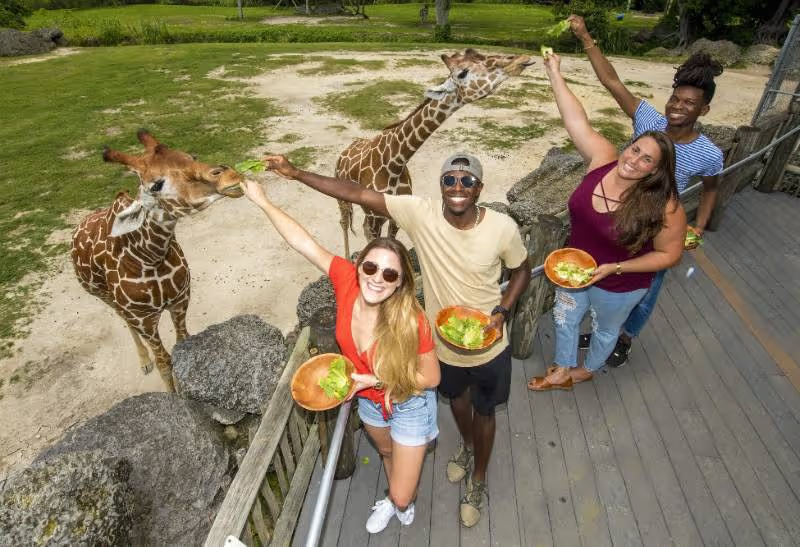
Owned by the Miami-Dade County Park and Recreation Department, the sprawling 740-acre Zoo Miami (12400 SW 152 St, Miami, FL 33177, 305-251-0400) features over 80 exhibits throughout its tropically landscaped grounds. With over 2,000 animals representing hundreds of species (including many endangered ones), it will keep you busy. Its 4 miles of walkways lead you past notable collections such as the Wings of Asia aviary with dozens of bird species; Dr. Wilde’s World, which houses thousands of honeybees; and Amazon and Beyond, opened in late 2008, which devotes 27 acres to the flora and fauna of South America. In the trees, be sure to look for the hundreds of orchids, cared for by the Eastern Airlines Orchid Society.
Tickets are affordable, Because the zoo is operated by the City. Admission in 2026 is $25.95 for adults 13+, $21.95 for children 3-12, free for 2 and under.. The grounds are open year-round from 9:30 am to 5:30 pm (gates close at 4 pm), so arrive early to enjoy the full experience.
Back in the 1950s, Florida was a sea of kitsch, with roadside attractions catering to traveling families on summer vacations. The advent of Disney World in the 1970s caused most of these mom-and-pop operations to falter and eventually close up shop, and they are presently an all-but-forgotten facet of life.
One of the few survivors is Monkey Jungle (14805 SW 216th St, Miami, FL 33170, 305-235-1611), a 30-acre park first established in 1933, “where the humans are caged and the monkeys run wild.”
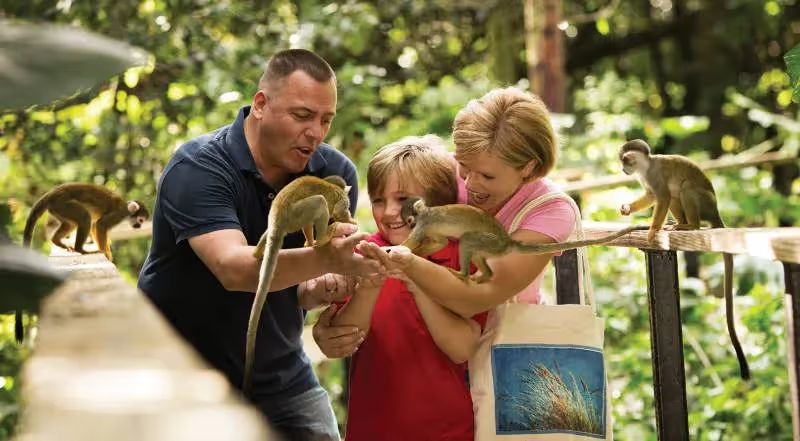
Upon arrival, you’ll pass through a gift shop where you can purchase your tickets (now $20 for adults, $10 for children 3-9, free under 3; taxes additional), and then step onto mesh-covered walkways, where you can observe several species of simians swinging through the trees and doing what monkeys do in a semi-natural tropical rainforest setting.
One of the most enjoyable aspects of a visit to Monkey Jungle is that you can purchase peanut and dried-fruit treats for a nominal fee near the entrance, and place them in little hanging baskets located along the walkways. The savvy monkeys will pull the baskets up to retrieve their contents and clang them for more when they’re done. As you sit back and watch them interact with one another, you’ll realize that we humans are not so different in our ways.
Monkey Jungle was at the zenith of its years in the early 1990s, until it was all-but destroyed by Hurricane Andrew in 1992; it has since made a rebound, though post-hurricane damage (and more recent storms) has affected some areas, making it a shadow of its former self in spots. The animals still make the trip worthwhile, however. Be sure to stick around for the gorilla show!
The park’s remote Southwest Miami location makes it a nice companion trip for Zoo Miami. Open daily from 9:45 am to 4:00 pm (ticket office closes at 4 pm; note that some experiences like guided rainforest tours may require advance booking and extra fees).
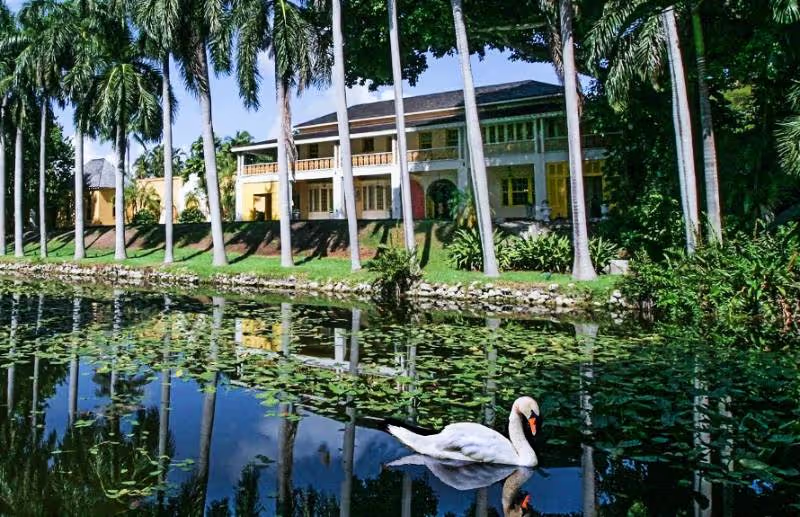
If you should find yourself further north in the Fort Lauderdale area, be sure to make time for the Bonnet House (900 North Birch Road, Fort Lauderdale, FL 33304, 954-563-5393). The 35-acre property, acquired in 1895 by Florida pioneer Hugh Taylor Birch, was given to his daughter Helen and her husband, Frederic Clay Bartlett, as a wedding gift in 1919. More recently, it was donated by the family to the Florida Trust for Historic Preservation, where the house is now a museum.
The grounds are what make this place special, though. Dazzling gardens and ponds graced with swans and frolicking turtles grab your attention, while wild monkeys scurry through the tree branches nearby.
How the monkeys got there is a mystery. Legend has it that they escaped from a traveling circus and were attracted to the beautiful grounds.
In addition to monkeys, raccoons are also plentiful. One even let me photograph him lounging around in one of the trees!
Admission for house and grounds (now $30 for adults self-guided, $8 for ages 6-17, free for 5 and under; Broward County residents $25; grounds-only $15) has risen, with guided options available. Hours are Tuesday–Sunday 11:00 am–4:00 pm (closed Mondays, major holidays, and occasionally for events like the Air Show). Gates close at 3:30 pm most days.
It’s no understatement to say that life in Florida is like having the cable channel Animal Planet in your backyard 24 hours a day. While many would associate the exotic nature of Miami with the international travelers that abound here, the animal population in the Magic City is no less colorful. In parks, gardens, and even the most urban of settings, wild creatures thrive here like nowhere else. In Miami, it really is a jungle out there!
Editor’s Note: Originally published August 21, 2009. Updated in 2026 with new photography; Doug Eames’ original writing remains unchanged.

Lorem ipsum dolor sit amet, consectetur adipiscing elit. Suspendisse varius enim in eros elementum tristique. Duis cursus, mi quis viverra ornare, eros dolor interdum nulla, ut commodo diam libero vitae erat. Aenean faucibus nibh et justo cursus id rutrum lorem imperdiet. Nunc ut sem vitae risus tristique posuere.
Lorem ipsum dolor sit amet, consectetur adipiscing elit. Suspendisse varius enim in eros elementum tristique. Duis cursus, mi quis viverra ornare, eros dolor interdum nulla, ut commodo diam libero vitae erat. Aenean faucibus nibh et justo cursus id rutrum lorem imperdiet. Nunc ut sem vitae risus tristique posuere.
Check out our top local tours on Miami Beach 411—no tourist traps, just the best adventures, Everglades, and more.
Book Your TourOr book your hotel through our Hotels.com partnership—it helps keep Miami Beach 411 free and independent for everyone.
Book Your Hotel

Comment disclaimer:
Some comments below originated on a previous version of MiamiBeach411.com. As a result of platform migrations, displayed comment dates may reflect import timestamps rather than original posting dates. Many comments date back to the early 2000s and capture community conversations from that time. If you have local insight, updates, or memories to share, we welcome your comments below.
This story has been part of Miami Beach conversations for decades—and it’s still unfolding. Add your voice.
Lorem ipsum dolor sit amet, consectetur adipiscing elit. Suspendisse varius enim in eros elementum tristique. Duis cursus, mi quis viverra ornare, eros dolor interdum nulla, ut commodo diam libero vitae erat. Aenean faucibus nibh et justo cursus id rutrum lorem imperdiet. Nunc ut sem vitae risus tristique posuere.
Lorem ipsum dolor sit amet, consectetur adipiscing elit. Suspendisse varius enim in eros elementum tristique. Duis cursus, mi quis viverra ornare, eros dolor interdum nulla, ut commodo diam libero vitae erat. Aenean faucibus nibh et justo cursus id rutrum lorem imperdiet. Nunc ut sem vitae risus tristique posuere.