

To promote the third season of Dexter, which premiered on September 28, Showtime took an unusual and clever marketing approach: a mock Rolling Stone magazine cover printed on the back of the actual magazine, accompanied by an eight-page ad supplement dedicated entirely to the series.
Rather than traditional ads, the campaign was designed to blur the line between fiction and reality—presenting Dexter Morgan as if he were a real public figure being profiled by Rolling Stone.

Inside the mock interview, Dexter lists Miami Beach 411 as his favorite “Site to Stalk,” citing the site’s coverage of Miami’s most infamous crimes. For us, it was a surreal and gratifying nod—one that recognized Miami Beach 411 as a trusted source for local history and true crime storytelling.
The mention highlights the work of Matt Meltzer, Carlos Miller, and Bill Cooke whose in-depth true crime articles helped define the site’s early voice. Their reporting focused not on sensationalism, but on historical context—examining how crime shaped Miami’s neighborhoods, culture, and reputation during pivotal decades.
In many ways, the reference made perfect sense. Dexter was deeply rooted in Miami’s identity, drawing inspiration from the city’s darker chapters while juxtaposing them against its glossy, sun-soaked image. Miami Beach 411’s true crime coverage explored that same contrast—looking beyond postcard Miami to the stories locals know well.

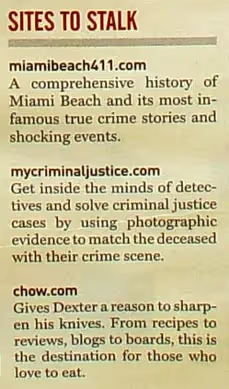
Being included in a Rolling Stone campaign placed Miami Beach 411 in rare company and marked a moment when local history blogging intersected with mainstream pop culture. It also reinforced the growing appetite for thoughtful, well-researched storytelling about Miami’s past—especially stories that don’t shy away from its complexities.
Are you watching Dexter this season? Do you think the show captures Miami accurately—or exaggerates its darker side?
Scroll down and leave a comment.
And if you’re not watching Dexter… you probably should be. 🩸

Lorem ipsum dolor sit amet, consectetur adipiscing elit. Suspendisse varius enim in eros elementum tristique. Duis cursus, mi quis viverra ornare, eros dolor interdum nulla, ut commodo diam libero vitae erat. Aenean faucibus nibh et justo cursus id rutrum lorem imperdiet. Nunc ut sem vitae risus tristique posuere.
Lorem ipsum dolor sit amet, consectetur adipiscing elit. Suspendisse varius enim in eros elementum tristique. Duis cursus, mi quis viverra ornare, eros dolor interdum nulla, ut commodo diam libero vitae erat. Aenean faucibus nibh et justo cursus id rutrum lorem imperdiet. Nunc ut sem vitae risus tristique posuere.
Check out our top local tours on Miami Beach 411—no tourist traps, just the best adventures, Everglades, and more.
Book Your TourOr book your hotel through our Hotels.com partnership—it helps keep Miami Beach 411 free and independent for everyone.
Book Your Hotel


Comment disclaimer:
Some comments below originated on a previous version of MiamiBeach411.com. As a result of platform migrations, displayed comment dates may reflect import timestamps rather than original posting dates. Many comments date back to the early 2000s and capture community conversations from that time. If you have local insight, updates, or memories to share, we welcome your comments below.
This story has been part of Miami Beach conversations for decades—and it’s still unfolding. Add your voice.
Lorem ipsum dolor sit amet, consectetur adipiscing elit. Suspendisse varius enim in eros elementum tristique. Duis cursus, mi quis viverra ornare, eros dolor interdum nulla, ut commodo diam libero vitae erat. Aenean faucibus nibh et justo cursus id rutrum lorem imperdiet. Nunc ut sem vitae risus tristique posuere.
Lorem ipsum dolor sit amet, consectetur adipiscing elit. Suspendisse varius enim in eros elementum tristique. Duis cursus, mi quis viverra ornare, eros dolor interdum nulla, ut commodo diam libero vitae erat. Aenean faucibus nibh et justo cursus id rutrum lorem imperdiet. Nunc ut sem vitae risus tristique posuere.